






What cc head do I need?

Thread Starter
Joined: Oct 2002
Posts: 523
Likes: 58
From: Winnipeg, Manitoba, Canada
 What cc head do I need?
 For a 427 Dart LS SHP block with 6cc valve relief.
I was told with a 68cc head and 0.053 thick gasket it would be 11.1:1 compression.
So checking my math, if I go with a 64 cc head would my compression be about 11.57:1 compression?
I was told with a 68cc head and 0.053 thick gasket it would be 11.1:1 compression.
So checking my math, if I go with a 64 cc head would my compression be about 11.57:1 compression?
I have 8cc valve reliefs with a 60cc chamber, .040 gaskets and my pistons come up .003 above deck and im at 12.49 compression.
Thread Starter
Joined: Oct 2002
Posts: 523
Likes: 58
From: Winnipeg, Manitoba, Canada
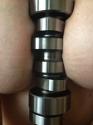
Cam is a 244/256 .629"/.604" 114+3
Heads are TFS 245cc.
We had to deck my block to clean up the decks on my dart shp block. After decking .006 we came up with .003 out the hole. You will need to know that and pick a head gasket after getting that . Shoot for around .037-.040 quench .
The cam would be fine at 11.5
The cam would be fine at 11.5
On 91, I would stay near 11.5 can push it some, but I have also seen at higher rpm, dynamic compression becomes unimportant and your static compression determines your detonation potential.
Go thinner on hg will help be more kr resistant.
Go thinner on hg will help be more kr resistant.

12 Second Club


Joined: Dec 2017
Posts: 1,034
Likes: 224
From: San Antonio
Trending Topics
LS1 Tech Stories
The Best V8 Stories One Small Block at Time

Topdon ONE vs. Artidiag 800 BT2: Which is the Diagnostic Tablet For You?
Pouria Savadkouei
Gas Monkey Built a 6-Wheel Ferrari Testarossa With a Corvette LT4 Engine
Verdad Gallardo
7 Most Reliable High-Performance Engines GM Has Ever Built
Verdad Gallardo
Amazing '71 Camaro Restomod Is Modern Muscle Car Under the Skin
Verdad Gallardo
6 Common C5 Corvette Failures and What's Involved In Repairing Them
Pouria Savadkouei
Retro Modern Bandit Pontiac Trans AM Comes With Burt Reynolds' Autograph
Verdad Gallardo
Top 10 Greatest Cadillac V Series Performance Models Ever, Ranked
Pouria Savadkouei
Top 10 Most Powerful Chevy Trucks Ever Made!

Hennessey's New Supercharged Silverado ZR2 Has 700 HP
Verdad Gallardo I'd run boostane anyway so you not limited by the fuel.
In an ideal world, the piston will just barely kiss the cylinder head deck, forcing ALL the mixture into the chamber. However, this is not realistic, for obvious reasons. And there is rod stretch with rpm. I figure between .025-.030 at 8K rpm, so set the quench just a bit higher than that for clearance. This allows for slight variation in piston deck heights. This is where the commonly accepted .036" ideal quench value is derived from.
What this does is force almost all the mixture into the chamber, so it all burns when it should, leaving no further fuel in the cylinder to detonate in a secondary burn event OR to burn early due to hot spots in the gap between the head and block. So even though compression is raised 0.2-0.3, the chance for a KR event is actually reduced.
Running a thicker head gasket allows more of the mixture to bleed into the notch between the block deck and head deck, which increases likelihood of an incorrectly timed burn or residual fuel in the chamber that then burns a second time. So even though with a thicker gasket, compression is reduced, the chances of KR are actually increased.
If you are concerned about cometic, felpro makes a .041 mls that works great.
Only issue I was ever aware of with cometic was on gen 3 engines with that stupid notch in the deck of the heads - 241 and 853 particularly
Only issue I was ever aware of with cometic was on gen 3 engines with that stupid notch in the deck of the heads - 241 and 853 particularly
12 Second Club
Joined: Dec 2017
Posts: 1,034
Likes: 224
From: San Antonio
It might not be the best calculator, but it will get you close. It doesn't have the piston to cylinder wall volume, or the head gasket bore/volume. I think it calculates everything else that you need though.
12 Second Club
Joined: Dec 2017
Posts: 1,034
Likes: 224
From: San Antonio
Thanks for the explanation Darth. That is interesting. I always assumed that detonation occurred within the combustion chamber. I never thought about the head gasket volume area. I assume that GM went with thicker gaskets to increase EGR for EPA purposes. Stock engines (especially trucks) already have low compression, so detonation probably isn't much of an issue.
Here's another thought...if you get a head gasket with the same bore as the cylinder, does the thickness really matter? If you could get a head gasket with the same bore as the cylinder, then there wouldn't be any "ledge" for un-burnt fuel to collect on. Since the OP is asking about compression and head gasket thickness, I figured this would still be relevant to the topic.
Here's another thought...if you get a head gasket with the same bore as the cylinder, does the thickness really matter? If you could get a head gasket with the same bore as the cylinder, then there wouldn't be any "ledge" for un-burnt fuel to collect on. Since the OP is asking about compression and head gasket thickness, I figured this would still be relevant to the topic.
Certainly if the chamber size is no bigger than the bore, AND you account for thermals- gasket grows slower than block - closer is better.
However, many times the chamber is wider than the bore. More common with aftermarket parts. In those cases you need to make sure the bore of the gasket exceeds the chamber diameter or you will not crush the fire ring.
Hope that makes sense.
However, many times the chamber is wider than the bore. More common with aftermarket parts. In those cases you need to make sure the bore of the gasket exceeds the chamber diameter or you will not crush the fire ring.
Hope that makes sense.
12 Second Club
Joined: Dec 2017
Posts: 1,034
Likes: 224
From: San Antonio
Yes. Yes it does. These are things that we need to keep in mind when we start swapping heads and boring cylinders to different sizes than what they came with.
I need to go re-measure the 706 heads that I have in the shed. I think the chambers are bigger (maybe 3.8") than the 5.3L bore (3.78"). That could be why GM used a 3.83" bore head gasket on the LM7.
I haven't measured any rec. port (823) heads yet. I suspect that they are bigger than the 4"-4.065" bore that they are used on, but smaller than the LS7 and bigger bores. That might make the 823 head a good choice on a 4.125" bore. That's assuming that you can find a head gasket with a 4.125" bore.
This might be over-thinking it, but if you are building an engine from the ground up, you might as well make everything as close to ideal as you can.
I need to go re-measure the 706 heads that I have in the shed. I think the chambers are bigger (maybe 3.8") than the 5.3L bore (3.78"). That could be why GM used a 3.83" bore head gasket on the LM7.
I haven't measured any rec. port (823) heads yet. I suspect that they are bigger than the 4"-4.065" bore that they are used on, but smaller than the LS7 and bigger bores. That might make the 823 head a good choice on a 4.125" bore. That's assuming that you can find a head gasket with a 4.125" bore.
This might be over-thinking it, but if you are building an engine from the ground up, you might as well make everything as close to ideal as you can.
Thread Starter
Joined: Oct 2002
Posts: 523
Likes: 58
From: Winnipeg, Manitoba, Canada
So I’m going to be using a DART NEXT LS 427 block.
I spoke with DART and they were adamant about using gaskets made for their block only. They said the cooling holes won’t line up otherwise and I’ll have issues if I use LS7 or any other gasket. Weird.
Didn’t make sense if I’m using LS heads. I’m using Trick Flow 245 cc heads.
So the only gasket I can use is a Felpro 0.051 gasket.
I spoke with DART and they were adamant about using gaskets made for their block only. They said the cooling holes won’t line up otherwise and I’ll have issues if I use LS7 or any other gasket. Weird.
Didn’t make sense if I’m using LS heads. I’m using Trick Flow 245 cc heads.
So the only gasket I can use is a Felpro 0.051 gasket.