




Progressive controller for big noids

Thread Starter
Staging Lane
Joined: Jun 2006
Posts: 89
Likes: 0
 Progressive controller for big noids
 Ive got the HSW bottom outlet N2O and fuel solenoids and Im looking for a simple progressive controller for them.
I dont want to downgrade the noids because Im going to be spraying a 300shot through them and dont want to max smaller noids out. Also my plumbing is finished and I really dont want to redo it.
I want to stick with a basic function (three **** style) controller because I already have a window switch, speed switch and timing retard built into my ecu. I also dont want to pay for an FJO.
Alternatively:
Is there any way that a Controller that is limited to ~30amps can control 2-20+ amp noids? Like using the output of the controller to trigger 2 different relays, 1 for each noid? I want to use the controller I have now but it just doesnt handle the load of both noids.
TIA,
Stefan
I dont want to downgrade the noids because Im going to be spraying a 300shot through them and dont want to max smaller noids out. Also my plumbing is finished and I really dont want to redo it.
I want to stick with a basic function (three **** style) controller because I already have a window switch, speed switch and timing retard built into my ecu. I also dont want to pay for an FJO.
Alternatively:
Is there any way that a Controller that is limited to ~30amps can control 2-20+ amp noids? Like using the output of the controller to trigger 2 different relays, 1 for each noid? I want to use the controller I have now but it just doesnt handle the load of both noids.
TIA,
Stefan
Thread Starter
Staging Lane
Joined: Jun 2006
Posts: 89
Likes: 0
Problem is, these noids draw a little over 20amps each. Even if it works once, would it fail to open them eventually?
My car already saw 15:1 AFRs on the dyno because of this, I'm hoping to avoid that again
My car already saw 15:1 AFRs on the dyno because of this, I'm hoping to avoid that again
You should recheck your amp draw. The N20 solenoids are typically over 20A but the fuel solenoids are usually under 10, (even big ones).
Originally Posted by scapaldo
Problem is, these noids draw a little over 20amps each. Even if it works once, would it fail to open them eventually?
My car already saw 15:1 AFRs on the dyno because of this, I'm hoping to avoid that again
My car already saw 15:1 AFRs on the dyno because of this, I'm hoping to avoid that again
Thread Starter
Staging Lane
Joined: Jun 2006
Posts: 89
Likes: 0
Ill definately check that out. When I found out that I had a problem, it was the fuel noid that wasn't opening. They were wired together but the wires directly to the fuel noid were about 12" longer.
The controller Im using is rated at 30A.
The controller Im using is rated at 30A.
You have a different problem than you think.
Just out of curiosity, did you do a full pull on the dyno? Did the A/F stay lean or was it only lean while the solenoids were pulsing?
Just out of curiosity, did you do a full pull on the dyno? Did the A/F stay lean or was it only lean while the solenoids were pulsing?
Thread Starter
Staging Lane
Joined: Jun 2006
Posts: 89
Likes: 0
It was a full pull, but I was just checking AFRs on 30%(~130hp) the whole time. It stayed very consistent throughout the pull also.
Triggering them with the car off and the N2O solenoid pulses but the fuel just clicks once very quietly. Disconnecting either solenoid results in a very strong pulse from the other one.
I wired a single relay to be triggered by the output of the controller instead of driving them directly and it didnt help at all. Im planning on trying to trigger 2 relays, one for each noid, and see if that works.
Triggering them with the car off and the N2O solenoid pulses but the fuel just clicks once very quietly. Disconnecting either solenoid results in a very strong pulse from the other one.
I wired a single relay to be triggered by the output of the controller instead of driving them directly and it didnt help at all. Im planning on trying to trigger 2 relays, one for each noid, and see if that works.
Trending Topics
Ok heres your issue:
1st do not run a relay off the output of the progressive controller. They can't take that abuse. they are not designed to be pulsed that fast, and burn up real quick.
2nd. Heres why your lean.
N20 is compressable and fuel isn't. When you run a big N20 solenoid it fills the line between it and the nozzle. The line acts like a resivoir, and the solenoid just keeps topping it off, while the actual flow rate through the jet stays nearly constant and at nearly 100% depending on the relationship between the Noid oriface and the jet oriface, as well as the line length. Since the fuel dosent compress it actually will run well at differnt %'s.
What to do? If your really set on running a progressive controller, try a small nitrous solenoid, with the same jetting. That makes a big difference.
What size jets are you using?
Vinny
1st do not run a relay off the output of the progressive controller. They can't take that abuse. they are not designed to be pulsed that fast, and burn up real quick.
2nd. Heres why your lean.
N20 is compressable and fuel isn't. When you run a big N20 solenoid it fills the line between it and the nozzle. The line acts like a resivoir, and the solenoid just keeps topping it off, while the actual flow rate through the jet stays nearly constant and at nearly 100% depending on the relationship between the Noid oriface and the jet oriface, as well as the line length. Since the fuel dosent compress it actually will run well at differnt %'s.
What to do? If your really set on running a progressive controller, try a small nitrous solenoid, with the same jetting. That makes a big difference.
What size jets are you using?
Vinny
Originally Posted by scapaldo
It was a full pull, but I was just checking AFRs on 30%(~130hp) the whole time. It stayed very consistent throughout the pull also.
Triggering them with the car off and the N2O solenoid pulses but the fuel just clicks once very quietly. Disconnecting either solenoid results in a very strong pulse from the other one.
I wired a single relay to be triggered by the output of the controller instead of driving them directly and it didnt help at all. Im planning on trying to trigger 2 relays, one for each noid, and see if that works.
Triggering them with the car off and the N2O solenoid pulses but the fuel just clicks once very quietly. Disconnecting either solenoid results in a very strong pulse from the other one.
I wired a single relay to be triggered by the output of the controller instead of driving them directly and it didnt help at all. Im planning on trying to trigger 2 relays, one for each noid, and see if that works.
LS1 Tech Stories
The Best V8 Stories One Small Block at Time

Topdon ONE vs. Artidiag 800 BT2: Which is the Diagnostic Tablet For You?
Pouria Savadkouei
Gas Monkey Built a 6-Wheel Ferrari Testarossa With a Corvette LT4 Engine
Verdad Gallardo
7 Most Reliable High-Performance Engines GM Has Ever Built
Verdad Gallardo
Amazing '71 Camaro Restomod Is Modern Muscle Car Under the Skin
Verdad Gallardo
6 Common C5 Corvette Failures and What's Involved In Repairing Them
Pouria Savadkouei
Retro Modern Bandit Pontiac Trans AM Comes With Burt Reynolds' Autograph
Verdad Gallardo
Top 10 Greatest Cadillac V Series Performance Models Ever, Ranked
Pouria Savadkouei
Top 10 Most Powerful Chevy Trucks Ever Made!

Hennessey's New Supercharged Silverado ZR2 Has 700 HP
Verdad Gallardo Thread Starter
Staging Lane
Joined: Jun 2006
Posts: 89
Likes: 0
Ill have to check on my jet sizes because I dont have them in front of me. The N2O not compressing does make sense but the fuel noid definately isnt pulsing. I went from ~11.5:1 on boost only to 14:1 on then it rose up to 15:1 as nitrous came on. (just rechecked the logs and dyno sheet)
Ill have to get back to you on jet sizes but its calculated at 4 nozzles 43psi fuel 950psi nitrous jetted to 300hp total. I would really like to progress it only for about a half second though, just to let the tires hook.
I also have the N20 and fuel noids staggered to try to prevent a lean spike.
Ill have to get back to you on jet sizes but its calculated at 4 nozzles 43psi fuel 950psi nitrous jetted to 300hp total. I would really like to progress it only for about a half second though, just to let the tires hook.
I also have the N20 and fuel noids staggered to try to prevent a lean spike.
Thread Starter
Staging Lane
Joined: Jun 2006
Posts: 89
Likes: 0
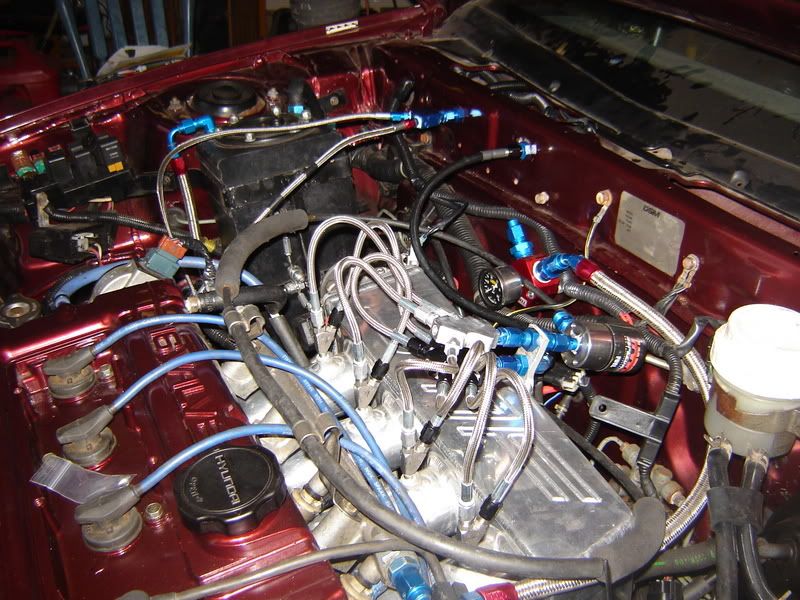
Heres what I mean by staggered. The fuel noid is now connected to the red splitter on the firewall. The N2O noid is in the wiper tray feeding the distribution block via the black line from the bulkhead. The bulkhead on the far left on the firewall is the 2nd stage, ingore that though.
o.k. that clears some things up. If your jetted to 300hp then you have properly sized noids.
Do yourself a favor, hook the noids back up to the progressive controller. Disconnect the fuel solenoid from the distribution block and point it into a bucket. With your bottle off,turn your fuel pump on, and pulse both solenoids. See if fuel sprays out. This is a much better test than listening to the noids. See if it is infact spraying or not.
If it is spraying fuel. They try 2 things.
1.Eliminate the long line between the N20 solenoid and the distribution block. This is an easy way to help prevent a lean spike, but dosen't work with progresive controllers.
2.Monitor fuel pressure during a dyno pull. Eveyrthying may be set-up right, but you will now need some serious fuel supply.
Do yourself a favor, hook the noids back up to the progressive controller. Disconnect the fuel solenoid from the distribution block and point it into a bucket. With your bottle off,turn your fuel pump on, and pulse both solenoids. See if fuel sprays out. This is a much better test than listening to the noids. See if it is infact spraying or not.
If it is spraying fuel. They try 2 things.
1.Eliminate the long line between the N20 solenoid and the distribution block. This is an easy way to help prevent a lean spike, but dosen't work with progresive controllers.
2.Monitor fuel pressure during a dyno pull. Eveyrthying may be set-up right, but you will now need some serious fuel supply.
Thread Starter
Staging Lane
Joined: Jun 2006
Posts: 89
Likes: 0
Ill try that with a bucket. Even though I am about 99% sure that its not fully opening. Running just the fuel noids results in feeling/hearing the loud clicking, far different from when it has the N2O noid hooked up with it. Its definately worth checking though.
Fuel supply shouldnt be a problem, Im running an A1000 pump with only 400whp on boost and -10 line feeding 2 -6 lines, 1 for the fuel rail, 1 for the fuel noid. The extra 130hp shouldnt have caused the massive lean condition. I can log nitrous activation in relation to AFR and there isnt a slow rise, it takes a huge jump on activation.
Fuel supply shouldnt be a problem, Im running an A1000 pump with only 400whp on boost and -10 line feeding 2 -6 lines, 1 for the fuel rail, 1 for the fuel noid. The extra 130hp shouldnt have caused the massive lean condition. I can log nitrous activation in relation to AFR and there isnt a slow rise, it takes a huge jump on activation.

Here's another controller, a little more $$, but you know the old saying... It can handle 4 of the big PRO noids at one time.

Nitrous Direct Controllers
Robert
Nitrous Direct Controllers
Robert