When you click on links to various merchants on this site and make a purchase, this can result in this site earning a commission. Affiliate programs and affiliations include, but are not limited to, the eBay Partner Network.
I'm a perfectionist... probably as you mentioned I didn't need to get a new stator but I bought a new one anyways. It would have drove me nuts knowing that nick was there. The only one that RockAuto carried was the sonnax one. It looks identical with ONE exception. Can see the extra port in the picture. I'm not sure why that hole is there? Obviously for some newer pump design and this is one size fits all... I presume is okay to use... the stator doesn't have any real torque on it? I'd imagine they virtually never break? That would be my only thought as the sonnax has less material there due to that extra hole... ?
Question 2: I'm a dumb Dora. I heated the pump half up to 550F for 40 minutes than dropped that stator in on my failed attempt. It fell right in no problem but I let it cool off suspended on two 2x4 pieces of wood. Well, some of that cellulose / wood burnt into the metal. I have been using a gray buffing pad (3m scotch bright light pad). Very gently polishing it off. It's taking forever and a day. I've also checked for flat again. It's flat as a pancake. I'm **** retentive though, I called a machine shop to see about simply planning that pump half. They were baffled when I said 4L60E *sigh*. I presume the pump should be fine even with that burnt wood residue / film on there? I also tried paint thinner on there... Not sure if something could soak that off, without harming the aluminum? Paint thinner had no effect.
I believe thats the incorrect stator for your application.
Regarding the film on the pump half, take scotchbrite and scuff if off. It should come off. There is another method but the green scotchbrite should do the trick
Thanks @vorteciroc & @2fast Oh crap you're right. I called Sonnax and they said that stator wouldn't work at all. That I need this one 77918S-1K which is for non-reluctor (no speed sensor). That had thrown me for a curve as the 77918S-1K says it fits up to 2004 and my pump is out of a 2005 hence why I ordered the other but seems is a transition year. I'm going to order it HERE
New question, good flat surface to sand for pump rotor? Or leave be? It turns freely but has less than 0.0015" clerance
I watched several tutorials on building the pump. I also have the ATSG manual which basically just check the rotor moves freely. I torqued my case halves to spec and checked this. It does spin freely. However, Dana at Pro Built Automatics specs this way... He says there should be 0.002" to 0.003" clearance for pump rotor HERE. I have less than 0.0015" - my smallest feeler 0.0015" won't fit but light does pass through when I use a flashlight to look under the flat edge.
Long story short, the linked procedure recommends sanding the rotor down with 400 grit to obtain 2tho to 3tho clearance. I don't have a flat granite slab though. Flattest surface I have is the granite in my kitchen. One corner of my island is to within less than 0.0015". Would it be prudent to knock a little off the rotor?
Otherwise maybe I could have a machine shop flatten a piece of steel for me. I see calibrated flat granite is like $500+ I actually am friends with a kitchen and bath company who let me sort their their scrap to try and find a flat piece but didn't yield decent results.
Last edited by weinerschizel; Oct 6, 2021 at 02:06 PM.
should have just left the old stator. are you going to lose sleep every time the transmission shifts and the clutches or band lose a micron of clutch lining? i've been guilty of this sort of thinking myself, just stop it. you've just cost your self more work and time for what? something no one will ever see or affect trans operation.
you could probably take a fine sharpening stone and go over the pump half. put the old stator back in and call it.
edit: as far as pump depth, i tried flat sanding on a piece of 3/4" glass when I did my first 700 10 years ago. was out .001". Ended up taking to a machine shop and gave them the slide, rotor and pump half and told them what I wanted. you can then check it with a straight edge and feeler to see where its at.
Yes 0.0015" is not enough clearance.
Use the clearances that Dana gave you.
Flat sanding will work just fine.
Just go at it slowly and carefully, so that things stay as flat as possible.
Will do. I will set a piece of wet 400 grit sandpaper on the flat corner of my island and take 1 thousandth off.
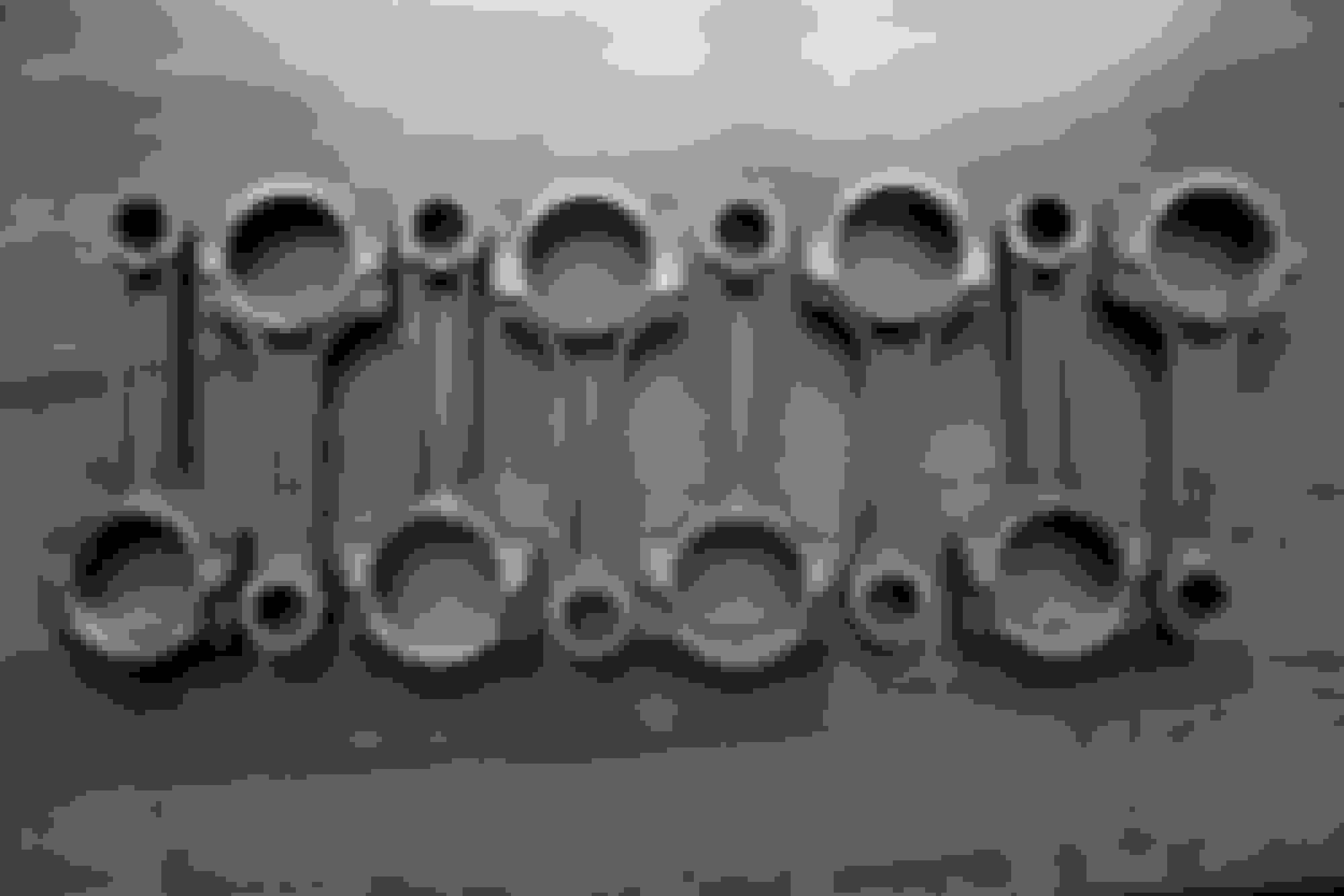
I polished my connecting rods for my engine build... but I used the flat deck on my scrap engine block. I should have kept the block as it worked like a champ although was a bit cumbersome.
The green scotch bright worked great for pump case. I lightly buffed for about 30 minutes then switched to to a gray one. Stayed flat as a pancake but really cleaned the surface up. Great advice you really are experienced
Last edited by weinerschizel; Oct 6, 2021 at 10:06 PM.
Thanks, @vorteciroc . I really like learning and doing things. Most of the fun for me is the build. They were a limited casting of oil squirter factory rods. Crazy enough I ended up selling them and using the normal factory casting. I wasn't sure if they would bleed oil pressure if any, then in the end realized they are last thing oiled so wouldn't have done anything much to pressure. I really probably should have put them in. I just polished the faces. They had some staining on them from the builder I got them from. I think I did some posts on here about my engine build. Honestly, kind of amazing how FEW people out in the real world build engines anymore, let alone transmissions.
I paid a shop to do that for me on the other ones I ended up using in my 6.0L. I spent forever trying to build my own rod weight scale. Didn't want to spend $200 on one cause I'm cheap lol But you need to buy one just could never get consistent readings even when I incorporated bearings in my design. The machine shop balanced everything on my rotating assembly to within 1 gram and put appropriate counterbalances on crank. Was pretty cheap, I think they only charged like $250 or something. Was amazed the 5.3L I tore down had 10 grams of variance in the rotating assembly. Lastly, I installed short throw hydraulic lifters from Johnson. Pretty sweet build. Really excited to get this higher stall torque converter in as it will fill in the small hole I have in torque down low. Despite the hole new motor is WAY more powerful even down low than the old 5.3L. Climbs like a beast off road just cracking the throttle where before I had to floor my truck with 5.3L.
Those look like oil squirters too... Did you modify them to have the chamfer? What are the wholes at top of wrist pin area?
They are not technically Oil-Squirters...
But they are Grooves in the Big-End that direct some of the Oil that gets sprayed-out towards the underside of the Piston.
This will cool the Pistons down some, like actual Oil-Squirters do (just not as well).
You are seeing one of the lubrication Holes in the Small-End...
They are used with "Floating" Wrist-Pins, in order to cool and lubricate the Rod and Wrist-Pin surfaces that rub together.
There will also be a thin Bushing in the Small-End (sometimes with Grooves for the Oil to spread).
Interesting, I'm reading the ATSG book now. It says to not install the springs. From the sound of what you are saying they were introduced in design to account for looser tolerances (easier build) at factory which from back in the day when I was an engineer makes perfect sense
Curious do you prefer to run on the low, middle, or high side of the tolerances for the clutch packs?
The update to that book retracts that and recommends using them. I feel like if they werent needed, GM wouldnt have put them in there. I ALWAYS put them in. I have had many units come to me that were previously rebuilt and the 3-4 was burned up. Many of them had the springs left out from previous builders. Coincidence maybe. But If it cost GM .25 to put them in each unit, and they built over a million units (probably more than that) then they lost $250k putting them in. Honestly, if they werent needed, in all of the updates that trans has had over the years, they would have left them out. think about that.
I run .035 to .045 3-4 clearance. Thats what works for me. I havent had a 3-4 burn up in probably at least 10 years
Anyone is free to do what they prefer, no doubt. But I feel like my reasoning is pretty sound and makes perfect sense. Plus the lack of 3-4 failures I’ve experienced also adds to my confidence of it.
One set of Springs holds the Clutch Apply Piston down (opposite of applying the Clutches).
The other set of Springs holds the Clutch Backing Plate up off of the Clutches.
These two sets of Springs are pushing in opposite directions.
There is no harm in using the stiffer Piston Return Springs with the Backing Plate Lift Springs.
depends how you look at it.
some think the outer set of springs is pushing the apply plate off the clutches (after all...the backing plate is fixed against the snap ring)
so they would be pushing in the same direction.
Regardless...doesn't matter...the idea of the outer springs is to ensure the clutch stack has forced separation to reduce drag.
This is beneficial in my opinion.
Not NECESSARY by any means...so the guys that say "I ran no springs for 20 years and no issues" are probably telling the truth. You don't need them.
But...it doesn't hurt a thing and when spinning 5500+ rpm the reduced drag is nice
Gas Monkey Built a 6-Wheel Ferrari Testarossa With a Corvette LT4 Engine
Slideshow: The controversial Ferrari F6 swaps its original flat-12 for a Corvette Z06-derived LT4 V8 and sends power to four rear wheels through a custom-built drivetrain.
7 Most Reliable High-Performance Engines GM Has Ever Built
Slideshow:These GM engines didn't just make huge power, they survived abuse, boost, track days, and six-digit mileage with a reputation for refusing to quit.
6 Common C5 Corvette Failures and What's Involved In Repairing Them
Slideshow: From wobbling harmonic balancers to failed EBCMs, these are the issues that define long-term C5 ownership and what repairs typically involve.
Retro Modern Bandit Pontiac Trans AM Comes With Burt Reynolds' Autograph
Slideshow: A modern Camaro transformed into a retro icon, this limited-run "Bandit" build blends nostalgia with brute force in a way few revivals manage.
Top 10 Greatest Cadillac V Series Performance Models Ever, Ranked
Slideshow: Cadillac didn't just crash the high-performance luxury vehicle party, it showed up loud, supercharged, and occasionally a little unhinged...












 I actually am friends with a kitchen and bath company who let me sort their their scrap to try and find a flat piece but didn't yield decent results.