






LSX oil pans

$40 is for the tube, the dipstick and two O-rings. Since mine will not be in until Saturday, you could post the part numbers for those 4 items for other guys considering this pan.
Last edited by speedtigger; Dec 9, 2010 at 10:05 AM.
Why would you need 2 o rings? Hmm. What you said was just the dipstick tube. I was just trying to offer a cheaper alternative to that one if they use a stock part. Since its more than that, the cost is somewhat justified then.
The exploded view showed 4 parts.
Dipstick tube
Dipstick
o-ring that goes on the top of the dipstick
o-ring that goes on the bottom of the dipstick tube
Now both the dipstick and the tube may have the o-ring included; I don't know. If they do, I can send the extras back.
Dipstick tube
Dipstick
o-ring that goes on the top of the dipstick
o-ring that goes on the bottom of the dipstick tube
Now both the dipstick and the tube may have the o-ring included; I don't know. If they do, I can send the extras back.

Staging Lane
Joined: Nov 2010
Posts: 71
Likes: 0
From: West Texas
The website pictures show a windage tray also. Let us know if it doesnt show up. Dont forget a new gasket, however i have heard you can reuse them several times.
Wonder how much the Holley pan will be?
Wonder how much the Holley pan will be?
LS1 Tech Stories
The Best V8 Stories One Small Block at Time

6 Common C5 Corvette Failures and What's Involved In Repairing Them
Pouria Savadkouei
Retro Modern Bandit Pontiac Trans AM Comes With Burt Reynolds' Autograph
Verdad Gallardo
Top 10 Greatest Cadillac V Series Performance Models Ever, Ranked
Pouria Savadkouei
Top 10 Most Powerful Chevy Trucks Ever Made!

Hennessey's New Supercharged Silverado ZR2 Has 700 HP
Verdad Gallardo
Coachbuilt N2A Anteros Is an LS2-Powered C6 Corvette In Italian Clothes
Verdad Gallardo
Awesome K5 Blazer Restomod Comes With C7 Corvette Power
Verdad Gallardo
10 Camaros You Should Never Buy

10 LS Engine Myths That Refuse to Die
Verdad Gallardo
Launching!
Joined: Jun 2009
Posts: 213
Likes: 3
From: Manitowoc wi.
Holley Ls Oil Pan Just a quick annoucement, JZMotorworks has been acquired by Holley Performance. We will no longer be offering this oil pan for purchase as our inventory has now been depleted. Please visit Holleys website to view an updated version of this cast aluminum pan.Thanks to all in past who purchased our product. Mark Zich


Fantastic thread.
Does anyone know the dimensions of the GMPP "Muscle Car Pan"? How does it compare to the F-bod LS1 pan. It sells for much cheaper and I want to see if this is an option.
EDIT. Looks like that kit contains the LH8 pan but I am still unlcear on its dimensions when compared to the F-bod pan.
EDIT #2. Looks like it is 2.5" deeper than the f-bod pan. Lots of info in this thread!
Does anyone know the dimensions of the GMPP "Muscle Car Pan"? How does it compare to the F-bod LS1 pan. It sells for much cheaper and I want to see if this is an option.
EDIT. Looks like that kit contains the LH8 pan but I am still unlcear on its dimensions when compared to the F-bod pan.
EDIT #2. Looks like it is 2.5" deeper than the f-bod pan. Lots of info in this thread!
Last edited by ShiftyCapone; Jan 4, 2011 at 09:43 AM.

Teching In
Joined: Dec 2010
Posts: 37
Likes: 0
From: Ft. Worth
Help!!!! Getting ready to cut my 98-2002 f-body pan to fit my 69 camaro. I'm using hooker mounts with stock manifolds for now. I need some help as far as measurements and where exactly to cut both the pan and pickup tube. Does anyone have a diagram I could follow or Helpful pictures? Advice also greatly appreciated...


Just a quick annoucement, JZMotorworks has been acquired by Holley Performance. We will no longer be offering this oil pan for purchase as our inventory has now been depleted. Please visit Holleys website to view an updated version of this cast aluminum pan.Thanks to all in past who purchased our product. Mark Zich
Although Holley’s GM LS Retrofit Oil Pan uses a traditional rear sump design, it maintains the factory LS five-quart oil capacity (six-quarts with filter) and structural rigidity. The external sump depth measures 5.89” from the mounting flange, 7.65” from the bell housing flange, and has an external sump width of 9.75”.

Getting ready to cut my 98-2002 f-body pan to fit my 69 camaro. I'm using hooker mounts with stock manifolds for now. I need some help as far as measurements and where exactly to cut both the pan and pickup tube. Does anyone have a diagram I could follow or Helpful pictures? Advice also greatly appreciated...
Teching In
Joined: Dec 2010
Posts: 37
Likes: 0
From: Ft. Worth
@ebk06
I have both pans, but I was wanting to use the f-body pan because it seemed easier to modify. Now for the truck pan, I have no idea on what and where to cut. I actually have no idea on where to cut neither one of them. This is why I was needing help.
I have both pans, but I was wanting to use the f-body pan because it seemed easier to modify. Now for the truck pan, I have no idea on what and where to cut. I actually have no idea on where to cut neither one of them. This is why I was needing help.

Autokraft LS Swap Oil Pan
Here are some detailed pictures of the one I bought and my personal thoughts:


I have to say I am very impressed with both the design and quality of fabrication of this pan. I have seen aftermarket pans for small blocks that didn't come close to the level of detail built into this thing.
The pan is constructed of a stamped section that formes the one-piece flange and front section of the pan and a welded/fabricated sump area that includes kickouts for capacity and active baffling for oil control. The efforts toward keeping oil around the pickup were my primary reason for selecting this pan over some of the others available. Here are some detailed pictures of the sump area


You can see the pan uses hinges as doors to keep oil around the pickup during cornering, braking, and acceleration. The hing travel is limited to opening about 45 degrees, which shold prevent the doors from sticking open.

Another detail to admire is the stitch-welded backup flange that adds thickness/stiffness around the perimeter of the pan to help keep things sealed.

The pan also includes a nicely machined spin-on oil filter adapter.

These o-rings seal the supply & return between the adapter and the oil pan. I was very happy to see the o-ring glands include room for the o-rings to compress, a detail that some (bad) engineers overlook. This should result in a good seal as long as the bolts clamping the adapter do their job.

I haven't looked up this filter yet, but here's what you're supposed to use for this pan.

The pan also includes this fabricated pickup assembly. I suspect (but dont' know for sure) this started life as an OEM assembly and was simply modified to accept the pickup in a new location. My only complaint here is some surface rust around the MIG welds that could have been prevented by oiling it down before storage. We'll see how well it lines up when I install the pan. I do plan to check the distance between the pickup and bottom of the pan.

Here are some detailed pictures of the one I bought and my personal thoughts:
I have to say I am very impressed with both the design and quality of fabrication of this pan. I have seen aftermarket pans for small blocks that didn't come close to the level of detail built into this thing.
The pan is constructed of a stamped section that formes the one-piece flange and front section of the pan and a welded/fabricated sump area that includes kickouts for capacity and active baffling for oil control. The efforts toward keeping oil around the pickup were my primary reason for selecting this pan over some of the others available. Here are some detailed pictures of the sump area
You can see the pan uses hinges as doors to keep oil around the pickup during cornering, braking, and acceleration. The hing travel is limited to opening about 45 degrees, which shold prevent the doors from sticking open.
Another detail to admire is the stitch-welded backup flange that adds thickness/stiffness around the perimeter of the pan to help keep things sealed.
The pan also includes a nicely machined spin-on oil filter adapter.
These o-rings seal the supply & return between the adapter and the oil pan. I was very happy to see the o-ring glands include room for the o-rings to compress, a detail that some (bad) engineers overlook. This should result in a good seal as long as the bolts clamping the adapter do their job.
I haven't looked up this filter yet, but here's what you're supposed to use for this pan.
The pan also includes this fabricated pickup assembly. I suspect (but dont' know for sure) this started life as an OEM assembly and was simply modified to accept the pickup in a new location. My only complaint here is some surface rust around the MIG welds that could have been prevented by oiling it down before storage. We'll see how well it lines up when I install the pan. I do plan to check the distance between the pickup and bottom of the pan.
Autokraft LS Swap Oil Pan
Here are some detailed pictures of the one I bought and my personal thoughts:
I have to say I am very impressed with both the design and quality of fabrication of this pan. I have seen aftermarket pans for small blocks that didn't come close to the level of detail built into this thing.
The pan is constructed of a stamped section that formes the one-piece flange and front section of the pan and a welded/fabricated sump area that includes kickouts for capacity and active baffling for oil control. The efforts toward keeping oil around the pickup were my primary reason for selecting this pan over some of the others available. Here are some detailed pictures of the sump area
You can see the pan uses hinges as doors to keep oil around the pickup during cornering, braking, and acceleration. The hing travel is limited to opening about 45 degrees, which shold prevent the doors from sticking open.
Another detail to admire is the stitch-welded backup flange that adds thickness/stiffness around the perimeter of the pan to help keep things sealed.
The pan also includes a nicely machined spin-on oil filter adapter.
These o-rings seal the supply & return between the adapter and the oil pan. I was very happy to see the o-ring glands include room for the o-rings to compress, a detail that some (bad) engineers overlook. This should result in a good seal as long as the bolts clamping the adapter do their job.
I haven't looked up this filter yet, but here's what you're supposed to use for this pan.
The pan also includes this fabricated pickup assembly. I suspect (but dont' know for sure) this started life as an OEM assembly and was simply modified to accept the pickup in a new location. My only complaint here is some surface rust around the MIG welds that could have been prevented by oiling it down before storage. We'll see how well it lines up when I install the pan. I do plan to check the distance between the pickup and bottom of the pan.
Here are some detailed pictures of the one I bought and my personal thoughts:
I have to say I am very impressed with both the design and quality of fabrication of this pan. I have seen aftermarket pans for small blocks that didn't come close to the level of detail built into this thing.
The pan is constructed of a stamped section that formes the one-piece flange and front section of the pan and a welded/fabricated sump area that includes kickouts for capacity and active baffling for oil control. The efforts toward keeping oil around the pickup were my primary reason for selecting this pan over some of the others available. Here are some detailed pictures of the sump area
You can see the pan uses hinges as doors to keep oil around the pickup during cornering, braking, and acceleration. The hing travel is limited to opening about 45 degrees, which shold prevent the doors from sticking open.
Another detail to admire is the stitch-welded backup flange that adds thickness/stiffness around the perimeter of the pan to help keep things sealed.
The pan also includes a nicely machined spin-on oil filter adapter.
These o-rings seal the supply & return between the adapter and the oil pan. I was very happy to see the o-ring glands include room for the o-rings to compress, a detail that some (bad) engineers overlook. This should result in a good seal as long as the bolts clamping the adapter do their job.
I haven't looked up this filter yet, but here's what you're supposed to use for this pan.
The pan also includes this fabricated pickup assembly. I suspect (but dont' know for sure) this started life as an OEM assembly and was simply modified to accept the pickup in a new location. My only complaint here is some surface rust around the MIG welds that could have been prevented by oiling it down before storage. We'll see how well it lines up when I install the pan. I do plan to check the distance between the pickup and bottom of the pan.

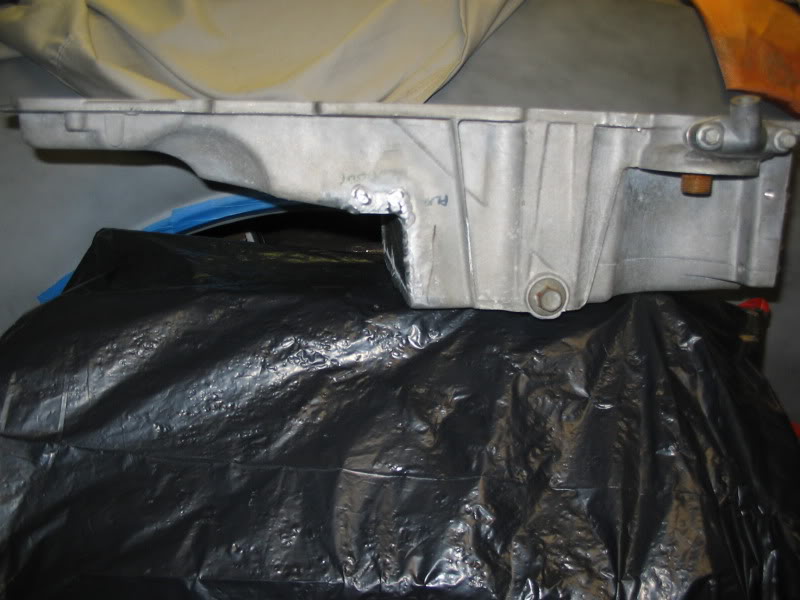
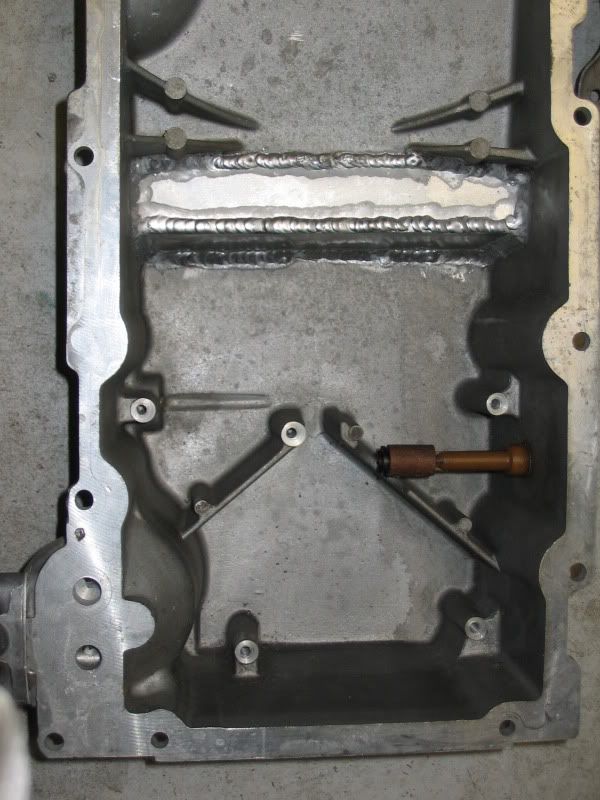
Oil Pan pics, this is my pan I installed with the ATS plates, GM rubber mounts, ATS trans crossmember, I measured enough to where a minimal cut was removed and a friend welded it up, then I cut the stock baffle on a sharp saw, end result it that the factory GM baffle can be used in a modded pan, I'm hoping I wn't have oil issues like a S&P pan,



TECH Resident


Joined: Apr 2008
Posts: 828
Likes: 12
From: Right here, right now!
Oil Pan pics, this is my pan I installed with the ATS plates, GM rubber mounts, ATS trans crossmember, I measured enough to where a minimal cut was removed and a friend welded it up, then I cut the stock baffle on a sharp saw, end result it that the factory GM baffle can be used in a modded pan, I'm hoping I wn't have oil issues like a S&P pan,
 .
.