


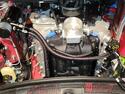


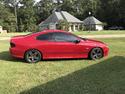

The Electric Turbo Camaro Project

Thread Starter
Teching In
Joined: Oct 2019
Posts: 45
Likes: 3
 The Electric Turbo Camaro Project
 Hey guys. I finally have my electric turbo in my possession and have begun development in earnest. I hope to have the install done by mid-late summer and will be taking videos of my progress to share with everyone. Here's the first installment. Enjoy 

TECH Fanatic
Joined: Jan 2010
Posts: 1,074
Likes: 17
From: sarasota fl
I havent watched vid yet, prob will answer all questions lol
Thats looks pretty cool! Is that a starter motor? What inspired you to do this?
do you have any idea/expectations how it will perform?
Thats looks pretty cool! Is that a starter motor? What inspired you to do this?
do you have any idea/expectations how it will perform?
Thread Starter
Teching In
Joined: Oct 2019
Posts: 45
Likes: 3
This was custom made for me by a guy who does this sort of electric boost work exclusively. He uses all sorts of surplus motors, depending on what sort of torque/speed response he needs. Sometimes he ends up re-winding the insides to get the desired response. This motor could have been from literally anything lol. The last unit I bought was the size of a small trash can (which was why I couldn't use it... too damn big) but they were definitely 2 completely different motors. Not sure what this was from though.
Of course time will tell what kind of performance I get BUT based on theoretical calculations, I should be able to get 6 PSI easy down near the 2000 RPM area and then it will fall off with increasing RPM until I'm getting no more than 2 PSI at redline (6600). This is unlike the profile normal compressors follow so I should end up with a VERY torquey and flat curve that doesn't push peak HP very much but makes for a very fast car nonetheless The perfect sleeper. Plus since it's all computer controlled, I can customize the shape of my torque curve arbitrarily and the nitrous will make up whatever deficit I can't realize from boost alone. My target is 650 ft-lbs and whatever HP.
Of course time will tell what kind of performance I get BUT based on theoretical calculations, I should be able to get 6 PSI easy down near the 2000 RPM area and then it will fall off with increasing RPM until I'm getting no more than 2 PSI at redline (6600). This is unlike the profile normal compressors follow so I should end up with a VERY torquey and flat curve that doesn't push peak HP very much but makes for a very fast car nonetheless
The perfect sleeper. Plus since it's all computer controlled, I can customize the shape of my torque curve arbitrarily and the nitrous will make up whatever deficit I can't realize from boost alone. My target is 650 ft-lbs and whatever HP. I admit I am a skeptic. But in for the results. If it works, I will be one of the first to order.
I don’t believe it will work based on the whole energy concept of physics, but I would love to be wrong.
I don’t believe it will work based on the whole energy concept of physics, but I would love to be wrong.
Thread Starter
Teching In
Joined: Oct 2019
Posts: 45
Likes: 3
I know it seems somewhat counter-intuitive given the plethora of crap out there that has been more of a restriction than anything else. However if you look at Tesla for example, they demonstrated in 1 fell swoop how an electric motor can beat the **** out of a gas engine any day of the week. I don't actually like that fact... I love gas, but going back to the physics, electromagnetism is 1 of the 4 universal forces and is actually much stronger than gravity and certainly chemical energy so making an electric blower comes down to how much magnetic material you can cram into a closed space and how many amps you can drive through it. If it weren't for the heat-sink fins on my unit it could have been a 20kW motor easy. But you are right - the proof is in the pudding. If you're willing to suspend judgement for now, I'm sure you'll be satisfied with the outcome.
Trending Topics
Let’s look at low RPM, 2k for example.
Will you move enough air? maybe. And will you be able to compress the air to create boost?
my old whipple made 6 psi at 2k. One thing was free spooling when not under load, another was it making boost. Even at low rpms it required/consumed a lot of energy.
Granted the difference here is that as RPMs go up, blowers spin faster. (Hence why they can keep making the same level of boost or even more than at lower RPMs)
Will you move enough air? maybe. And will you be able to compress the air to create boost?
my old whipple made 6 psi at 2k. One thing was free spooling when not under load, another was it making boost. Even at low rpms it required/consumed a lot of energy.
Granted the difference here is that as RPMs go up, blowers spin faster. (Hence why they can keep making the same level of boost or even more than at lower RPMs)
LS1 Tech Stories
The Best V8 Stories One Small Block at Time

6 Common C5 Corvette Failures and What's Involved In Repairing Them
Pouria Savadkouei
Retro Modern Bandit Pontiac Trans AM Comes With Burt Reynolds' Autograph
Verdad Gallardo
Top 10 Greatest Cadillac V Series Performance Models Ever, Ranked
Pouria Savadkouei
Top 10 Most Powerful Chevy Trucks Ever Made!

Hennessey's New Supercharged Silverado ZR2 Has 700 HP
Verdad Gallardo
Coachbuilt N2A Anteros Is an LS2-Powered C6 Corvette In Italian Clothes
Verdad Gallardo
Awesome K5 Blazer Restomod Comes With C7 Corvette Power
Verdad Gallardo
10 Camaros You Should Never Buy

10 LS Engine Myths That Refuse to Die
Verdad Gallardo I support any effort to make this work. I love the idea. But the physics evades me. Maybe I am not all that smart. I don’t assume to know everything.
re:Tesla: Electric motors make hella torque. They are big. They are heavy. And they take a lot of energy to spin.
you can create boost with a big enough electric motor. But how are you going to power it?
coming back to the whole energy thing. You will need more juice than the 12 volt system and xxx amp battery in the car will provide.
re:Tesla: Electric motors make hella torque. They are big. They are heavy. And they take a lot of energy to spin.
you can create boost with a big enough electric motor. But how are you going to power it?
coming back to the whole energy thing. You will need more juice than the 12 volt system and xxx amp battery in the car will provide.
Thread Starter
Teching In
Joined: Oct 2019
Posts: 45
Likes: 3
Thing about whipples and the like... well all supers really, is that they're coupled to the engine so they track the RPM. The way compressors work, they really only make pressure once they spin sufficiently fast. They do nothing at low speed, so the boost gains with RPM.
An electric unit is the complete opposite. Because it's not coupled to anything, you can just command whatever you want at any RPM. And since increasing demand for air creates vacuum, if I just turn the unit on 100% it will create max boost at 2000 for example and fall off with increasing revs. So it would be rather easy to make 5 psi for example at 2000 but difficult at 6000 where your whipple would be spinning plenty fast to maintain its boost levels.
An electric unit is the complete opposite. Because it's not coupled to anything, you can just command whatever you want at any RPM. And since increasing demand for air creates vacuum, if I just turn the unit on 100% it will create max boost at 2000 for example and fall off with increasing revs. So it would be rather easy to make 5 psi for example at 2000 but difficult at 6000 where your whipple would be spinning plenty fast to maintain its boost levels.
Thread Starter
Teching In
Joined: Oct 2019
Posts: 45
Likes: 3
Re: the electrical physics - motors care primarily about current, as this is what establishes the magnetic flux that produces a torque. The voltage is not that important and comes down to how the armature and stator are wound (how many turns, gauge, etc). My unit accepts up to 30V and I'm driving it with 24. But what matter is the 300 amps. The LiPo I spec'd can do 300 amps by itself so no issue there. And when Power = I^2 R (the current squared times the magnetic impedance), you see that big amp values produce a lot of power for those windings to energize, irrespective of the voltage.
I get that. The electric blower speed is independent. If kept constant boost will fall as engine rpm increases.
I am just not seeing the physics of it.
In a system, you will always pull out less energy than you put in. There are losses.
So to get more HP out of the car, a typical blower burns more fuel to create energy.
Where is the energy to create boost going to come from? Let’s say you add 50 HP at 2000 rpm. What is powering that? Not burning fuel because we are talking electric power.
So we are talking battery (voltage/amps)
I know how big my 2 hp pool pump is. I know how much juice it pulls. And that is for 2 HP.
All I am trying to understand is where the power will come to spin a compressor fast/hard enough to create a power increase.
I am just not seeing the physics of it.
In a system, you will always pull out less energy than you put in. There are losses.
So to get more HP out of the car, a typical blower burns more fuel to create energy.
Where is the energy to create boost going to come from? Let’s say you add 50 HP at 2000 rpm. What is powering that? Not burning fuel because we are talking electric power.
So we are talking battery (voltage/amps)
I know how big my 2 hp pool pump is. I know how much juice it pulls. And that is for 2 HP.
All I am trying to understand is where the power will come to spin a compressor fast/hard enough to create a power increase.
Thing about whipples and the like... well all supers really, is that they're coupled to the engine so they track the RPM. The way compressors work, they really only make pressure once they spin sufficiently fast. They do nothing at low speed, so the boost gains with RPM.
An electric unit is the complete opposite. Because it's not coupled to anything, you can just command whatever you want at any RPM. And since increasing demand for air creates vacuum, if I just turn the unit on 100% it will create max boost at 2000 for example and fall off with increasing revs. So it would be rather easy to make 5 psi for example at 2000 but difficult at 6000 where your whipple would be spinning plenty fast to maintain its boost levels.
An electric unit is the complete opposite. Because it's not coupled to anything, you can just command whatever you want at any RPM. And since increasing demand for air creates vacuum, if I just turn the unit on 100% it will create max boost at 2000 for example and fall off with increasing revs. So it would be rather easy to make 5 psi for example at 2000 but difficult at 6000 where your whipple would be spinning plenty fast to maintain its boost levels.

9 Second Club
Joined: Nov 2003
Posts: 13,616
Likes: 185
From: Norn Iron
If you do not even understand the meme....it shows how far you'll go with the nonsense you propose. I guess this is a school project for you ? What age are you ? 13, 14, 15 ?
As a project fire away....failure is a good way to learn.
Thread Starter
Teching In
Joined: Oct 2019
Posts: 45
Likes: 3
So at the beginning of the chain, you have the battery, which is not the car battery but a separate battery. It supplies 300 amps at 24V so that's about 9.6 HP of electrical energy, which goes to the motor that's bolted to the turbo housing.
So now you have 9.6HP of electricity turning a turbo housing. Normally in a procharger that would be accomplished by a belt and the 9.6HP would come directly from your engine but we can disregard that loss because the engine isn't connected.
The 9.6HP turbo is now spinning just as it normally would with a belt and producing... whatever... 70 lbs/min of air flow, which is being pushed into my engine.
In my car's computer, since I'm running open loop, the VE table checks the MAP sensor, sees the extra pressure, looks that up in the VE table and along with the RPM, finds the amount of fuel it needs and sends that to the fuel injectors, commanding them to spray more.
In short, this long sequence of events does lead to the car spraying more fuel to manage the extra air that is coming in.
So now you have 9.6HP of electricity turning a turbo housing. Normally in a procharger that would be accomplished by a belt and the 9.6HP would come directly from your engine but we can disregard that loss because the engine isn't connected.
The 9.6HP turbo is now spinning just as it normally would with a belt and producing... whatever... 70 lbs/min of air flow, which is being pushed into my engine.
In my car's computer, since I'm running open loop, the VE table checks the MAP sensor, sees the extra pressure, looks that up in the VE table and along with the RPM, finds the amount of fuel it needs and sends that to the fuel injectors, commanding them to spray more.
In short, this long sequence of events does lead to the car spraying more fuel to manage the extra air that is coming in.
300 amps, 24 volts = 8 HP Rounding
How will that generate more power at the rear wheels? Forcing air, then burning more fuel. I get that. But how does it sustain it over a pass/run? Are we taking batteries and increased voltage/amp generation?
Like I said, I don’t claim to know everything and I love innovative thinking. But I just don’t see the energy loop back piece here.
How will that generate more power at the rear wheels? Forcing air, then burning more fuel. I get that. But how does it sustain it over a pass/run? Are we taking batteries and increased voltage/amp generation?
Like I said, I don’t claim to know everything and I love innovative thinking. But I just don’t see the energy loop back piece here.
I am in transit right now so I can’t pull extra info needed.
I see what you are saying, but are you factoring in the issue of boost?
one thing is creating CFM (flow) another is stacking the air to create boost.
I don’t recall the equation and the formula (I am old and was last in college 20 years ago) but I recall it was a quadratic formula when it came down to flow and boost. They are not the same.
Live the idea, just don’t get the physics. But would love to be wrong. Please keep this thread going with results.
I see what you are saying, but are you factoring in the issue of boost?
one thing is creating CFM (flow) another is stacking the air to create boost.
I don’t recall the equation and the formula (I am old and was last in college 20 years ago) but I recall it was a quadratic formula when it came down to flow and boost. They are not the same.
Live the idea, just don’t get the physics. But would love to be wrong. Please keep this thread going with results.
Thread Starter
Teching In
Joined: Oct 2019
Posts: 45
Likes: 3
That will happen rest assured. I just want to make sure I'm articulating myself properly so I'm not misleading you.
If you're talking about recharging the battery, I have no provision for that yet, so the battery will drain until depleted, which at full load takes about 1 minute. So the boost will only last for maybe half a dozen pulls at a time. This IS a limitation right now. I could hook up a recharge circuit that would only work when the thing is off but that's down the road.
Your other question was about boost and flow. You are correct. Flow is easy but boost is a quadratic relationship. It's called "compressor work" and the more boost you make, the more energy (2nd order equation) it takes to get it. That's why it only takes maybe 2 HP to "keep up" with the LS3's flow demands but takes 9 to produce any sort of boost at redline.
If you're talking about recharging the battery, I have no provision for that yet, so the battery will drain until depleted, which at full load takes about 1 minute. So the boost will only last for maybe half a dozen pulls at a time. This IS a limitation right now. I could hook up a recharge circuit that would only work when the thing is off but that's down the road.
Your other question was about boost and flow. You are correct. Flow is easy but boost is a quadratic relationship. It's called "compressor work" and the more boost you make, the more energy (2nd order equation) it takes to get it. That's why it only takes maybe 2 HP to "keep up" with the LS3's flow demands but takes 9 to produce any sort of boost at redline.
Thread Starter
Teching In
Joined: Oct 2019
Posts: 45
Likes: 3
I was alive when TNG was on the air. Does that answer your question? Now stop embarrassing yourself.


You would be better served to have a high voltage source used to generate the power and use a buck converter to get the high current. Sure power is i^2R but it's also VI. If you're going to spend all the effort why not go all out and shoot for >100A peak. Were making a power supply that will do 150W at 70C and is the size of a 9V battery lol.
Thread Starter
Teching In
Joined: Oct 2019
Posts: 45
Likes: 3
Not sure I am on the same page. My battery will deliver >100 (300A actually) and I have never seen any sort of buck converter that can handle several kW and fit in a car. MOSFETs and other necessary ICs are severely bottlenecked by size and heat dissipating capacity at those power levels. You'd need to carry around industrial infrastructure when it's unnecessary. You really don't need high voltage to get the job done. You could do the job with 2V if you wind the motor correctly. I know P=VI but that's academic only. It's the current that does the work and even if we can't agree on current vs voltage, it's the power (the product of V and I) that decides how much air you get from the blower so 10kW is 10kW, whether it's 10V and 100A or 100V and 10A. The real question is whether the power rating of the motor is satisfactory or not and I believe it is. If you check this source, you can approximate the necessary power required:
https://www.engineeringtoolbox.com/h...ir-d_1363.html
Use 722 for CFM and then add whatever boost you like to 14.7 for the pressure field (15.7, 16.7, etc)
https://www.engineeringtoolbox.com/h...ir-d_1363.html
Use 722 for CFM and then add whatever boost you like to 14.7 for the pressure field (15.7, 16.7, etc)