







View Poll Results: Heatsoak using a metal intake.
Myth


35
50.72%
Real


34
49.28%
Voters: 69. You may not vote on this poll
Heat Soak..

Thread Starter
On The Tree
Joined: Feb 2007
Posts: 182
Likes: 0
 Heat Soak..
 O.k. this poll is to hopefully get some facts to prove or disprove heatsoak using metal intakes. No matter what the kind. fyi Im thinking about picking up a ported bbk w/tb setup. And kinda turned off to the amout of heatsoak talk being slinged around. So what do you think? Myth or Real. Try and provide evidence to back your theory.
It's a fact that the metal intake has more heat capacity
and conducts that stored heat better to the air stream.
Question is, how much temp rise really happens at WOT
given the brief time the air spends in the runner there.
A thermocouple reading at the intake port of the head
would be swell, if someone with a nitrous-boss-fitted
metal manifold, a thermocouple temperature meter and
way too much spare time cared to take data.
Outside of that it's all going to be speculaton and hearsay.
I'm thinking about barrier coating the inside if I can find a
trustworthy process & vendor. Wouldn't want ceramic
flakes in my motor etc. But it'd be nice if data said "so
what?".
and conducts that stored heat better to the air stream.
Question is, how much temp rise really happens at WOT
given the brief time the air spends in the runner there.
A thermocouple reading at the intake port of the head
would be swell, if someone with a nitrous-boss-fitted
metal manifold, a thermocouple temperature meter and
way too much spare time cared to take data.
Outside of that it's all going to be speculaton and hearsay.
I'm thinking about barrier coating the inside if I can find a
trustworthy process & vendor. Wouldn't want ceramic
flakes in my motor etc. But it'd be nice if data said "so
what?".
its bullshit get the metal intake....when you wanna spray the car there is no worry of the pos plastic blowin to bits and possibly ruinin your engine.......i can take a laser thermometor to my car with weiand and my sisters with the stocker and theres very lil difference.......hell using the same method the heads are way hotter than the manifold so i guess all our heads are heat soaking...guess someone needs to design a plastic cylinder head so we all can gain.00000000000000000000001 rwhp...........
get the bbk and call it a day.....it looks better and is capable of outflowing the ls6...hell its metal it can accept a real port job.....
this heat soak **** kills me
get the bbk and call it a day.....it looks better and is capable of outflowing the ls6...hell its metal it can accept a real port job.....
this heat soak **** kills me
????????????
Originally Posted by jimmyblue
It's a fact that the metal intake has more heat capacity
and conducts that stored heat better to the air stream.
Question is, how much temp rise really happens at WOT
given the brief time the air spends in the runner there.
A thermocouple reading at the intake port of the head
would be swell, if someone with a nitrous-boss-fitted
metal manifold, a thermocouple temperature meter and
way too much spare time cared to take data.
Outside of that it's all going to be speculaton and hearsay.
I'm thinking about barrier coating the inside if I can find a
trustworthy process & vendor. Wouldn't want ceramic
flakes in my motor etc. But it'd be nice if data said "so
what?".
and conducts that stored heat better to the air stream.
Question is, how much temp rise really happens at WOT
given the brief time the air spends in the runner there.
A thermocouple reading at the intake port of the head
would be swell, if someone with a nitrous-boss-fitted
metal manifold, a thermocouple temperature meter and
way too much spare time cared to take data.
Outside of that it's all going to be speculaton and hearsay.
I'm thinking about barrier coating the inside if I can find a
trustworthy process & vendor. Wouldn't want ceramic
flakes in my motor etc. But it'd be nice if data said "so
what?".
Originally Posted by 5_02ls1
its bullshit get the metal intake....when you wanna spray the car there is no worry of the pos plastic blowin to bits and possibly ruinin your engine.......i can take a laser thermometor to my car with weiand and my sisters with the stocker and theres very lil difference.......hell using the same method the heads are way hotter than the manifold so i guess all our heads are heat soaking...guess someone needs to design a plastic cylinder head so we all can gain.00000000000000000000001 rwhp...........
get the bbk and call it a day.....it looks better and is capable of outflowing the ls6...hell its metal it can accept a real port job.....
this heat soak **** kills me
get the bbk and call it a day.....it looks better and is capable of outflowing the ls6...hell its metal it can accept a real port job.....
this heat soak **** kills me

Trending Topics
LS1 Tech Stories
The Best V8 Stories One Small Block at Time

6 Common C5 Corvette Failures and What's Involved In Repairing Them
Pouria Savadkouei
Retro Modern Bandit Pontiac Trans AM Comes With Burt Reynolds' Autograph
Verdad Gallardo
Top 10 Greatest Cadillac V Series Performance Models Ever, Ranked
Pouria Savadkouei
Top 10 Most Powerful Chevy Trucks Ever Made!

Hennessey's New Supercharged Silverado ZR2 Has 700 HP
Verdad Gallardo
Coachbuilt N2A Anteros Is an LS2-Powered C6 Corvette In Italian Clothes
Verdad Gallardo
Awesome K5 Blazer Restomod Comes With C7 Corvette Power
Verdad Gallardo
10 Camaros You Should Never Buy

10 LS Engine Myths That Refuse to Die
Verdad Gallardo
Tech Resident
Joined: Jan 2006
Posts: 5,117
Likes: 3
From: Philly

The amount of time the air spends in the intake manifold isn't nearly long enough for the air to heat up even if the metal intake does get hotter than the plastic. As already said, all the real track cars use a metal intake, anyway. If plastic had the same strength as metal, I'd definitely choose plastic, but if strength is an issue, don't let the "heat soak" argument ruin it for you. Every time I hear someone mention the "heat soak" argument, I shake my head in pity...and want to bang it against the table.


I'm gettin ready to install my Port/Polished Lingenfelter intake on my H/C set-up. I'm really excited about it. And like said before, the air isn't in the runners any longer than the heads, so there isn't even enough heat added especially while racing to make a power difference.
I got mine for the added strength & ability to be port/polished.
I got mine for the added strength & ability to be port/polished.

I like the LS6 intake. As far heat soak goes. Air in a pipe does not move at the wall and moves the fastest in the center. I do not think the air would be heated much.
I didn't vote, but I absolutely believe it's real. Quantity
is the question. My gut says you'll see it large at idle
(but so what?) and minimal at WOT. There's a guy in the
Advanced section who posted up a TB-heating calculation
and I want to see if the same can get done for manifold
runners.
is the question. My gut says you'll see it large at idle
(but so what?) and minimal at WOT. There's a guy in the
Advanced section who posted up a TB-heating calculation
and I want to see if the same can get done for manifold
runners.

TECH Senior Member
iTrader: (1)
Joined: Apr 2005
Posts: 8,807
Likes: 0
From: Vancouver,[KITSILANO].B.C. Canada *WestCoast*

I voted real..scratch that...although metal stays hotter than plastic---thats a fact......also it is NOT a Myth when oldschool CAST IRON intakes were used......That is why I voted real...did not read far enough... 

Well I tried debating this over a year and a half ago. It's a long thread and does have some useful info https://ls1tech.com/forums/showthrea...0&page=1&pp=20

LS1Tech Sponsor
Joined: Feb 2006
Posts: 1,170
Likes: 1
From: Rockfield Kentucky
I didn't vote but my opinion is that it's real. Why? because I have dyno'd it both ways on an engine dyno and chassis dyno. We let the intake heat soak and we also iced it down.
But you have to consider many things.
While the plastic is less able to retain and transfer heat it also works for the cold. We Ice the intakes because it's worth 10 to 15 horsepower on the combination we ran. It was a non intercooled supercharged engine that made from 16 to 22 pounds of boost depending on the rules at that moment.
Intake air temps were in the 250 to 290 range.
You cannot get the same cooling effect from a plastic intake that has been iced.
In drag racing most of the heat is transfered from the heads. If you change water or cool the car between rounds then a aluminum manifold will be worth the effort.
If it's a road race car or you don't have the ability to cool it between rounds then the plastic intake would be best.
I have a cooler that circulates the coolant while the car is in the pits. I can get the water temp down to 58 degrees with an ambient of 90. THe car will warm up some during the burnout but not to normal temps. It's worth .05 to .09 on that car.
Robin
But you have to consider many things.
While the plastic is less able to retain and transfer heat it also works for the cold. We Ice the intakes because it's worth 10 to 15 horsepower on the combination we ran. It was a non intercooled supercharged engine that made from 16 to 22 pounds of boost depending on the rules at that moment.
Intake air temps were in the 250 to 290 range.
You cannot get the same cooling effect from a plastic intake that has been iced.
In drag racing most of the heat is transfered from the heads. If you change water or cool the car between rounds then a aluminum manifold will be worth the effort.
If it's a road race car or you don't have the ability to cool it between rounds then the plastic intake would be best.
I have a cooler that circulates the coolant while the car is in the pits. I can get the water temp down to 58 degrees with an ambient of 90. THe car will warm up some during the burnout but not to normal temps. It's worth .05 to .09 on that car.
Robin
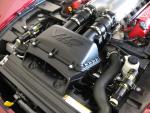
Another vote for real...it doesn't take much brain power to prove that it is real.
Now the real question, and one that is really at the heart of the matter:
Would the average end user even notice?
Most likely not.
Now the real question, and one that is really at the heart of the matter:
Would the average end user even notice?
Most likely not.
^^Exactly. Your not gonna notice any power loss, especially if it port/polished. The air simply isn't in the intake long enough to matter. But like said above, in traffic your air intake temmp. will go up some from the plastic, but once you start moving fresh air is back in again.