








need guidance dome vs dish/

Thread Starter
TECH Fanatic
Joined: Jun 2006
Posts: 1,326
Likes: 0
From: Hayward CA
 need guidance dome vs dish/
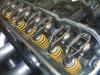
 Im really stumped ... I havent been able to start my rebuild on my 404 because im debating on which way to go.. My old set up was running a diamond piston with -4cc relief.. And my compression with my ls3 heads was around 11:7:1 and was built for nitrous.. So anyways now that i have the motor out im thinkin about steppin up the compression by using dome pistons .. Would there be any drawbacks? My heads are at 64cc .. Would i run into problems with ny heads? Would i be able to do a pump/race gas mix? Btw its going into 99z28 with a th400 and 12bolt car.
You're better off getting compression from pistons rather than the heads themselves. Further milling not only weakens the deck (especially true for OEM castings) but also disrupts airflow a tad.
Most if not all aftermarket pistons have pretty decent valve pockets so you shouldn't run into PTV issues. And other than that as long as you have your quench setup correctly you shouldn't run into issues with the piston dome. Just make sure you get the appropriate valve pocket for them given the heads and/or valve size. I know several manufacturers make different reliefs if running small valved cathedral heads vs. big valved rectangular/square port heads.
Most if not all aftermarket pistons have pretty decent valve pockets so you shouldn't run into PTV issues. And other than that as long as you have your quench setup correctly you shouldn't run into issues with the piston dome. Just make sure you get the appropriate valve pocket for them given the heads and/or valve size. I know several manufacturers make different reliefs if running small valved cathedral heads vs. big valved rectangular/square port heads.
Give us a call & we can help you select a piston & kick around options. We have tons of pistons in stock & might even have a good option for ya!! 
__________________
Jason
Co-Owner, Texas Speed & Performance, Ltd.
2005 Twin Turbo C6
404cid Stroker, 67mm Twins
994rwhp/902lb ft @ 22 psi (mustang dyno) www.Texas-Speed.com
Jason
Co-Owner, Texas Speed & Performance, Ltd.
2005 Twin Turbo C6
404cid Stroker, 67mm Twins
994rwhp/902lb ft @ 22 psi (mustang dyno) www.Texas-Speed.com
Thread Starter
TECH Fanatic
Joined: Jun 2006
Posts: 1,326
Likes: 0
From: Hayward CA
My motor was built by u guys like 5 yrs ago.. So maybe we could discuss the options..but im not in a hurry to get anything yet .. Still keepin options open.
FWIW nitrous combos don't quite respond to compression like NA combos for a few reasons. First NOS has a higher oxygen content so in effect it's like artificial atmosphere. Second the higher compression set-ups tend to narrow your tuning window. Making it substantially harder to maintain longevity. I've used juice quite a bit back in the day and have had friends scatter every imaginable combination there is. The one quote that has always rang in the back of my head came from Bill Glidden; "I can make more power on the dyno with a 13 or 14:1 engine but they will almost never run faster on the track than my 11 to one combos"
From my own personal spray combos, the only one's to take it and live, time and time again were 9,10, and 11 to one engines. Literally every single 12,13, or 14 to one engine I've ever built or helped friends tune has put down killer numbers with minimal life span at best. Constant head gasket or ring land issues...different gas types, different cam designs, thicker head gaskets, different pill sizes and fuel pressures, all the bullshit you can think of to no avail.
Buy all your rebuild parts from Texas Speed and the fact that they did your engine 5 years ago is why you still have an engine to freshen. They're damn good over there...but if it were me, I'd keep the compression right where it's at and work on cam, juice, and chassis/converter combos to get more from the car.
From my own personal spray combos, the only one's to take it and live, time and time again were 9,10, and 11 to one engines. Literally every single 12,13, or 14 to one engine I've ever built or helped friends tune has put down killer numbers with minimal life span at best. Constant head gasket or ring land issues...different gas types, different cam designs, thicker head gaskets, different pill sizes and fuel pressures, all the bullshit you can think of to no avail.
Buy all your rebuild parts from Texas Speed and the fact that they did your engine 5 years ago is why you still have an engine to freshen. They're damn good over there...but if it were me, I'd keep the compression right where it's at and work on cam, juice, and chassis/converter combos to get more from the car.
Thread Starter
TECH Fanatic
Joined: Jun 2006
Posts: 1,326
Likes: 0
From: Hayward CA
I thought nitrous liked compression...and yea texas speed had the best xustomer service when i was talking to them when they were doin my motor. They always kept on returning my calls and discussing issues and stuff so well see when im ready what thr plans are.
FWIW nitrous combos don't quite respond to compression like NA combos for a few reasons. First NOS has a higher oxygen content so in effect it's like artificial atmosphere. Second the higher compression set-ups tend to narrow your tuning window. Making it substantially harder to maintain longevity. I've used juice quite a bit back in the day and have had friends scatter every imaginable combination there is. The one quote that has always rang in the back of my head came from Bill Glidden; "I can make more power on the dyno with a 13 or 14:1 engine but they will almost never run faster on the track than my 11 to one combos"
From my own personal spray combos, the only one's to take it and live, time and time again were 9,10, and 11 to one engines. Literally every single 12,13, or 14 to one engine I've ever built or helped friends tune has put down killer numbers with minimal life span at best. Constant head gasket or ring land issues...different gas types, different cam designs, thicker head gaskets, different pill sizes and fuel pressures, all the bullshit you can think of to no avail.
Buy all your rebuild parts from Texas Speed and the fact that they did your engine 5 years ago is why you still have an engine to freshen. They're damn good over there...but if it were me, I'd keep the compression right where it's at and work on cam, juice, and chassis/converter combos to get more from the car.
From my own personal spray combos, the only one's to take it and live, time and time again were 9,10, and 11 to one engines. Literally every single 12,13, or 14 to one engine I've ever built or helped friends tune has put down killer numbers with minimal life span at best. Constant head gasket or ring land issues...different gas types, different cam designs, thicker head gaskets, different pill sizes and fuel pressures, all the bullshit you can think of to no avail.
Buy all your rebuild parts from Texas Speed and the fact that they did your engine 5 years ago is why you still have an engine to freshen. They're damn good over there...but if it were me, I'd keep the compression right where it's at and work on cam, juice, and chassis/converter combos to get more from the car.
nitrous IS compression. At 33% oxygen content it's WAY more violent than the 20% that we breath.
the 2 molecules of nitrogen are present to act as a buffer since pure oxygen would explode like a bomb.
The simplest way I can explain what it does is....It elevates the cylinder pressure to the point of breaking ****. Wanna know what your weak link is: spray it.
A few years ago we built a 9:1 555 BBC with Dart Pro 1 heads and a 270 solid roller cam. Now NA this thing would have needed at least 12.5 compression but the way we did it was to have it pump 100 psi of cranking compression. Similar to an old worn out tired *** wagon engine...LOL
In a 3600 pound 79 Malibu with a 1.69 glide and an ultra tight 11 inch converter with 3.50 gears it ran 11 ohs @ 124 on *****. Disgustingly lazy right ???
On a .093" jet plate with a 1000 cfm square flange (no dominator) it ran 9.2 @ 148 and did so for hundreds of bottles.....never even clipped a plug..
the 2 molecules of nitrogen are present to act as a buffer since pure oxygen would explode like a bomb.
The simplest way I can explain what it does is....It elevates the cylinder pressure to the point of breaking ****. Wanna know what your weak link is: spray it.
A few years ago we built a 9:1 555 BBC with Dart Pro 1 heads and a 270 solid roller cam. Now NA this thing would have needed at least 12.5 compression but the way we did it was to have it pump 100 psi of cranking compression. Similar to an old worn out tired *** wagon engine...LOL
In a 3600 pound 79 Malibu with a 1.69 glide and an ultra tight 11 inch converter with 3.50 gears it ran 11 ohs @ 124 on *****. Disgustingly lazy right ???
On a .093" jet plate with a 1000 cfm square flange (no dominator) it ran 9.2 @ 148 and did so for hundreds of bottles.....never even clipped a plug..
Trending Topics
LS1 Tech Stories
The Best V8 Stories One Small Block at Time

6 Common C5 Corvette Failures and What's Involved In Repairing Them
Pouria Savadkouei
Retro Modern Bandit Pontiac Trans AM Comes With Burt Reynolds' Autograph
Verdad Gallardo
Top 10 Greatest Cadillac V Series Performance Models Ever, Ranked
Pouria Savadkouei
Top 10 Most Powerful Chevy Trucks Ever Made!

Hennessey's New Supercharged Silverado ZR2 Has 700 HP
Verdad Gallardo
Coachbuilt N2A Anteros Is an LS2-Powered C6 Corvette In Italian Clothes
Verdad Gallardo
Awesome K5 Blazer Restomod Comes With C7 Corvette Power
Verdad Gallardo
10 Camaros You Should Never Buy
