




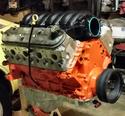





5.3l Cam Ideas
 5.3l Cam Ideas
 Hello everyone. I am in the early research phase of building an LS powered 75 Vega. My goal is for it to be a street/strip car that does low 12's at altitude (Bandimere).
What I'm thinking right now after doing some reading is that a 5.3l with a cam might be what I'm looking for. (there are a ton of 5.3's in the junk yards after all)
I'm guessing the car will probably weigh around 2800lbs when it's all built (the weight of the V8 Monza), so I won't need as much engine as a Camaro or Vette would to get the same results. The car is also emissions exempt.
My research so far has me looking at the Comp XR281HR. Have any of you run this cam (or similar) in a 5.3l with the stock head ports? (and valve springs, headers and a decent intake of course) What numbers and drivability did you get? I'm guessing it would generate around 380rwhp at sea level.
What I'm thinking right now after doing some reading is that a 5.3l with a cam might be what I'm looking for. (there are a ton of 5.3's in the junk yards after all)
I'm guessing the car will probably weigh around 2800lbs when it's all built (the weight of the V8 Monza), so I won't need as much engine as a Camaro or Vette would to get the same results. The car is also emissions exempt.
My research so far has me looking at the Comp XR281HR. Have any of you run this cam (or similar) in a 5.3l with the stock head ports? (and valve springs, headers and a decent intake of course) What numbers and drivability did you get? I'm guessing it would generate around 380rwhp at sea level.

TECH Junkie


Joined: Dec 2012
Posts: 3,614
Likes: 1,326
From: Iowa
Lots of variables here. Which 5.3? LM7,l33,l59? Compression makes a huge difference i'm sure you're well aware. Also, which heads? 862,799,706, etc?
With the right mix, you could knock on the door of your hp goals.
As far as et/mph that's gonna have a lot to do with converter,gear, and tire size.
More information will help guys here give you more accurate responses and help guide you where you want/need to go.
With the right mix, you could knock on the door of your hp goals.
As far as et/mph that's gonna have a lot to do with converter,gear, and tire size.
More information will help guys here give you more accurate responses and help guide you where you want/need to go.
I agree with the above. That cam might make 380rwhp in a 5.7 with ls1 heads, but not a 5.3 with stock truck heads unless its one of the 5.3s that came with 799/243 heads.
But please do yourself a favor and order a cam from a vendor who sponsors the site and does not use Comp cam cores which are prone to failure.
Cam Motion is my go to but Engine Power Systems (EPS), Martin Smallwood, and Brian Tooley racing can all spec you a cam and get it ground on a Cam Motion core for you.
Texas Speed now uses Callies cores which I'm not familiar with but are probably still much better than Comp.
Any of the above will be a better product, have better customer support, and should come with a Cam Dr report showing your cam is ground correctly.
The typical price is only $50 more which is a bargain compared to replacing a $400 cam and a $100-150 set of lifters.
But please do yourself a favor and order a cam from a vendor who sponsors the site and does not use Comp cam cores which are prone to failure.
Cam Motion is my go to but Engine Power Systems (EPS), Martin Smallwood, and Brian Tooley racing can all spec you a cam and get it ground on a Cam Motion core for you.
Texas Speed now uses Callies cores which I'm not familiar with but are probably still much better than Comp.
Any of the above will be a better product, have better customer support, and should come with a Cam Dr report showing your cam is ground correctly.
The typical price is only $50 more which is a bargain compared to replacing a $400 cam and a $100-150 set of lifters.

TECH Addict
Joined: Jul 2013
Posts: 2,189
Likes: 123
From: Portland, Oregon
Call Martin Smallwood. Here are some of the 5.3 cams he has spec'ed...
206/206 .560/.540 114+4
217/225 .637/.620 114+3
224/228 .604/.595 112+2
226/230 .612/.603 111+2
230/234 .612/.595 111+2
I'm thinking that 224/228 cam will be close to what you want for that little car.
206/206 .560/.540 114+4
217/225 .637/.620 114+3
224/228 .604/.595 112+2
226/230 .612/.603 111+2
230/234 .612/.595 111+2
I'm thinking that 224/228 cam will be close to what you want for that little car.
TECH Addict
Joined: Jul 2013
Posts: 2,189
Likes: 123
From: Portland, Oregon
Kip's 205/210 .510/.510 115+4 would be an excellent street cam for this car. Cam motion's stage two truck cam is 212/216 .518/.510 114-4, and it would probably provide a little more up top, for some fun hooning action.
Martin uses cam motion cores, which are about as good as it gets, so I would stick with Martin Smallwood or cam motion for your cam.
Martin uses cam motion cores, which are about as good as it gets, so I would stick with Martin Smallwood or cam motion for your cam.
Trending Topics
LS1 Tech Stories
The Best V8 Stories One Small Block at Time

6 Common C5 Corvette Failures and What's Involved In Repairing Them
Pouria Savadkouei
Retro Modern Bandit Pontiac Trans AM Comes With Burt Reynolds' Autograph
Verdad Gallardo
Top 10 Greatest Cadillac V Series Performance Models Ever, Ranked
Pouria Savadkouei
Top 10 Most Powerful Chevy Trucks Ever Made!

Hennessey's New Supercharged Silverado ZR2 Has 700 HP
Verdad Gallardo
Coachbuilt N2A Anteros Is an LS2-Powered C6 Corvette In Italian Clothes
Verdad Gallardo
Awesome K5 Blazer Restomod Comes With C7 Corvette Power
Verdad Gallardo
10 Camaros You Should Never Buy

10 LS Engine Myths That Refuse to Die
Verdad Gallardo
Hello everyone. I am in the early research phase of building an LS powered 75 Vega. My goal is for it to be a street/strip car that does low 12's at altitude (Bandimere).
What I'm thinking right now after doing some reading is that a 5.3l with a cam might be what I'm looking for. (there are a ton of 5.3's in the junk yards after all)
I'm guessing the car will probably weigh around 2800lbs when it's all built (the weight of the V8 Monza), so I won't need as much engine as a Camaro or Vette would to get the same results. The car is also emissions exempt.
My research so far has me looking at the Comp XR281HR. Have any of you run this cam (or similar) in a 5.3l with the stock head ports? (and valve springs, headers and a decent intake of course) What numbers and drivability did you get? I'm guessing it would generate around 380rwhp at sea level.
What I'm thinking right now after doing some reading is that a 5.3l with a cam might be what I'm looking for. (there are a ton of 5.3's in the junk yards after all)
I'm guessing the car will probably weigh around 2800lbs when it's all built (the weight of the V8 Monza), so I won't need as much engine as a Camaro or Vette would to get the same results. The car is also emissions exempt.
My research so far has me looking at the Comp XR281HR. Have any of you run this cam (or similar) in a 5.3l with the stock head ports? (and valve springs, headers and a decent intake of course) What numbers and drivability did you get? I'm guessing it would generate around 380rwhp at sea level.
The power stroke also becomes important on a limited atmosphere deal like this one. Since there will be less air/fuel mixture trapped in the cylinder due to the loss in atmosphere at your altitude you will also generate less cylinder pressure. For anywhere close to the same amount of work to be put to the crankshaft on the power stroke with this loss in cylinder pressure, the exhaust valve cannot open too early. This later opening event will help to make back some of the torque you will lose at your altitude from the loss in cylinder pressure.
The last thing that must be altered is the length of the overlap event. Overlap can lose charge to the exhaust system at low engine speed. This takes away from the air/fuel mixture that could fill the cylinder resulting in more low speed torque production. Since you are already working with less atmosphere to begin with, any loss in air/fuel mixture to the exhaust system really hurts your bottom end torque production. Because of this overlap must also be limited somewhat versus an engine running at sea level.
If you would like a recommendation for a cam, and possibly order it from me I would be glad to help you choose the proper cam. I will need to know a little bit more info though.
If you'd like you can call me, email me or PM me here on tech and I'll be glad to assist with your cam selection and any other engine/valve train related questions you have or parts that you will need.
Hope this helps!
Last edited by Martin Smallwood; Nov 21, 2015 at 04:09 PM.
TECH Addict
Joined: Jul 2013
Posts: 2,189
Likes: 123
From: Portland, Oregon
Wow. So today at lunch, I was literally just thinking about what the difference in cam specs would be for a car at sea level and the same car in Denver. My personal belief was later IVC, less overlap. Looks like both are correct. Good to know.
Once again, Martin, thank you for the science lesson. I always love how informative your explanations are.
Once again, Martin, thank you for the science lesson. I always love how informative your explanations are.
David,
It would actually be an earlier IVC event. Since there is less charge inertia due to the intake charge having less mass, cylinder filling will diminish sooner on the compression stroke.
I like to explain charge inertia as a rock rolling downhill. The taller the hill and the heavier/larger the rock is the more inertia(momentum) the rock gains as it rolls downhill. Think of the rock continuing to roll even after the hill flattens out as the cylinder filling that occurs once the piston reverses direction and heads back towards TDC on the compression stroke. Just because the piston is no longer travelling down the bore creating a depression in the cylinder in which atmosphere can then fill, doesn't mean that cylinder filling doesn't continue to occur. Due to the inertia created on the intake stroke, cylinder filling on the compression stroke (known as inertia ram effect) continues to occur even as the piston starts to compress the intake charge.
There will come a point though where charge inertia is overcome by cylinder pressure. At this point it's time to close the intake valve to trap the maximum amount of air/fuel mixture in the cylinder as possible.
No problem sir! Just trying to spread some knowledge!
It would actually be an earlier IVC event. Since there is less charge inertia due to the intake charge having less mass, cylinder filling will diminish sooner on the compression stroke.
I like to explain charge inertia as a rock rolling downhill. The taller the hill and the heavier/larger the rock is the more inertia(momentum) the rock gains as it rolls downhill. Think of the rock continuing to roll even after the hill flattens out as the cylinder filling that occurs once the piston reverses direction and heads back towards TDC on the compression stroke. Just because the piston is no longer travelling down the bore creating a depression in the cylinder in which atmosphere can then fill, doesn't mean that cylinder filling doesn't continue to occur. Due to the inertia created on the intake stroke, cylinder filling on the compression stroke (known as inertia ram effect) continues to occur even as the piston starts to compress the intake charge.
There will come a point though where charge inertia is overcome by cylinder pressure. At this point it's time to close the intake valve to trap the maximum amount of air/fuel mixture in the cylinder as possible.
No problem sir! Just trying to spread some knowledge!
Last edited by Martin Smallwood; Nov 20, 2015 at 07:46 PM.

Teching In
Joined: Nov 2015
Posts: 10
Likes: 0
From: Akron, Oh
Just because the piston is no longer travelling down the bore creating a depression in the cylinder in which atmosphere can then fill, doesn't mean that cylinder filling doesn't continue to occur. Due to the inertia created on the intake stroke, cylinder filling on the compression stroke (known as inertia ram effect) continues to occur even as the piston starts to compress the intake charge.

taking advantage of that effect on NA cars is probably one of the single largest factors that come into cam design. lol im running a 214/220 .540/.535 115+2 on my 5.3, IMO wouldnt go over 220 duration on either side for a 5.3 for most street applications.
Teching In
Joined: Nov 2015
Posts: 10
Likes: 0
From: Akron, Oh
Are there any off the shelf cams that are comparable to that profile spawne32? I have a 4.8l on an engine stand right now and I'm looking at options. It will have PAC1218's and will see around town cruising so I want to limit overall lift/duration. I want a smallish cam that will still wake the car up. I was honestly looking at getting a used pre-2000 LS1 cam from someone on the marketplace but I think I'm too much of a newbie to post/pm there.
Are there any off the shelf cams that are comparable to that profile spawne32? I have a 4.8l on an engine stand right now and I'm looking at options. It will have PAC1218's and will see around town cruising so I want to limit overall lift/duration. I want a smallish cam that will still wake the car up. I was honestly looking at getting a used pre-2000 LS1 cam from someone on the marketplace but I think I'm too much of a newbie to post/pm there.
In my sticky "Why LSA doesn't matter", I explain how to harness exhaust scavenging and pressure wave tuning in the intake port, and how to turn it all into additional volumetric efficiency.