








Drilled/Slotted

Thread Starter
Teching In
Joined: Sep 2010
Posts: 46
Likes: 0
From: Ft.Lauderdale, FL
 Drilled/Slotted
 I think this is the right place for this, if not, mods, do your thing. I bought my car with Drilled/slotted rotors on it already. Long story short, rotors got warped, changed the pads, now the brakes make a high pitched noise, even while not applied. When the brakes are applied the noise does get slightly louder, but it is NOT speed dependent. The noise im hearing does not get louder as I go faster. My question is, are there "certain" pads that these rotors need? The car did not make this noise before the new pads were put on.
Last edited by JustAnotherLS2; Sep 23, 2010 at 06:23 PM.
pads dont warp, only rotors do. you can not turn drilled and slotted rotors. What kind of pad did you replace with? if they are ceramics give them a few hundred miles to break in.
Hello, you might try some ceramic pads if you put semi-metallic's on it.
Brake squealing is produced by high-frequency vibration in the brakes. With disc brakes, vibrations can occur between the pads and rotors; the pads and calipers; the calipers and mounts; and/or within the rotors themselves loose or missing anti-rattle clips, a good cleaning and inspection for loose or missing parts would be a good start too.
Permatex makes a product called disc brake quiet and can be found in most auto parts stores, did you apply any such compound to the back of the pads ??
hope this points you in the right direction and gives you a couple ideas.
good luck and keep us posted on what you find.
Brake squealing is produced by high-frequency vibration in the brakes. With disc brakes, vibrations can occur between the pads and rotors; the pads and calipers; the calipers and mounts; and/or within the rotors themselves loose or missing anti-rattle clips, a good cleaning and inspection for loose or missing parts would be a good start too.
Permatex makes a product called disc brake quiet and can be found in most auto parts stores, did you apply any such compound to the back of the pads ??
hope this points you in the right direction and gives you a couple ideas.
good luck and keep us posted on what you find.
Thread Starter
Teching In
Joined: Sep 2010
Posts: 46
Likes: 0
From: Ft.Lauderdale, FL
Hello, you might try some ceramic pads if you put semi-metallic's on it.
Brake squealing is produced by high-frequency vibration in the brakes. With disc brakes, vibrations can occur between the pads and rotors; the pads and calipers; the calipers and mounts; and/or within the rotors themselves loose or missing anti-rattle clips, a good cleaning and inspection for loose or missing parts would be a good start too.
Permatex makes a product called disc brake quiet and can be found in most auto parts stores, did you apply any such compound to the back of the pads ??
hope this points you in the right direction and gives you a couple ideas.
good luck and keep us posted on what you find.
Brake squealing is produced by high-frequency vibration in the brakes. With disc brakes, vibrations can occur between the pads and rotors; the pads and calipers; the calipers and mounts; and/or within the rotors themselves loose or missing anti-rattle clips, a good cleaning and inspection for loose or missing parts would be a good start too.
Permatex makes a product called disc brake quiet and can be found in most auto parts stores, did you apply any such compound to the back of the pads ??
hope this points you in the right direction and gives you a couple ideas.
good luck and keep us posted on what you find.
Wrong. Yes you can. I've done it lots of times on Brembos, Wilwood, etc.
To the OP, take your rotors to a competent machine shop and they'll resurface your rotors. If you just did a pad slap without cutting the rotors the glaze on the rotors combined with new pads will sometimes cause squeaking as you are experiencing.
Wrong. Yes you can. I've done it lots of times on Brembos, Wilwood, etc.
To the OP, take your rotors to a competent machine shop and they'll resurface your rotors. If you just did a pad slap without cutting the rotors the glaze on the rotors combined with new pads will sometimes cause squeaking as you are experiencing.
To the OP, take your rotors to a competent machine shop and they'll resurface your rotors. If you just did a pad slap without cutting the rotors the glaze on the rotors combined with new pads will sometimes cause squeaking as you are experiencing.
Why people insist on using drilled and slotted rotor when they offer absolutely no benefits - and are actually less effective and safe than - blanks is unfathomable to me.
And removing even more material from an already-cut-down (and useless) drilled and slotted design simply means the rotors will heat up faster, be more likely to warp, and more likely to crack.
Why people insist on using drilled and slotted rotor when they offer absolutely no benefits - and are actually less effective and safe than - blanks is unfathomable to me.
Why people insist on using drilled and slotted rotor when they offer absolutely no benefits - and are actually less effective and safe than - blanks is unfathomable to me.
Trending Topics
And removing even more material from an already-cut-down (and useless) drilled and slotted design simply means the rotors will heat up faster, be more likely to warp, and more likely to crack.
Why people insist on using drilled and slotted rotor when they offer absolutely no benefits - and are actually less effective and safe than - blanks is unfathomable to me.
Why people insist on using drilled and slotted rotor when they offer absolutely no benefits - and are actually less effective and safe than - blanks is unfathomable to me.
Like Jimbo98z said, why do so many high end performance cars come equipped with rotors like these if they're so useless as you claim?
LS1 Tech Stories
The Best V8 Stories One Small Block at Time

Topdon ONE vs. Artidiag 800 BT2: Which is the Diagnostic Tablet For You?
Pouria Savadkouei
Gas Monkey Built a 6-Wheel Ferrari Testarossa With a Corvette LT4 Engine
Verdad Gallardo
7 Most Reliable High-Performance Engines GM Has Ever Built
Verdad Gallardo
Amazing '71 Camaro Restomod Is Modern Muscle Car Under the Skin
Verdad Gallardo
6 Common C5 Corvette Failures and What's Involved In Repairing Them
Pouria Savadkouei
Retro Modern Bandit Pontiac Trans AM Comes With Burt Reynolds' Autograph
Verdad Gallardo
Top 10 Greatest Cadillac V Series Performance Models Ever, Ranked
Pouria Savadkouei
Top 10 Most Powerful Chevy Trucks Ever Made!

Hennessey's New Supercharged Silverado ZR2 Has 700 HP
Verdad Gallardo Cracking due to cross-drilling can be minimized if the rotors are cast with the holes, rather than actually having them drilled, but you still create stress risers.
Why do the expensive cars have them? Same reason people with cheap cars have them - looks. Take a look at what the real auto-cross and road race guys are running - not cross-drilled and slotted rotors.
Taking .005-.010 off a rotor to clean it up isn't going to render it useless. Why do you think they crossdrill and slot rotors in the first place? Yep, to help cool down the rotor and increase stopping power. Less fade and less warpage occurs.
Like Jimbo98z said, why do so many high end performance cars come equipped with rotors like these if they're so useless as you claim?
Like Jimbo98z said, why do so many high end performance cars come equipped with rotors like these if they're so useless as you claim?
Cross-drilled and slotted aren't "useless" as in not functional - they simply provide absolutely no benefits, at all, for a car running anything approximating brake pads that are safe to use on the street, and honestly, I don't even think race pads outgas enough to warrant cross-drilled rotors anymore.
Why do so many road-race guys use blanks if the "big-name performance cars" come with cross-drilled rotors?

Thread Starter
Teching In
Joined: Sep 2010
Posts: 46
Likes: 0
From: Ft.Lauderdale, FL
Taking .005-.010 off a rotor to clean it up isn't going to render it useless. Why do you think they crossdrill and slot rotors in the first place? Yep, to help cool down the rotor and increase stopping power. Less fade and less warpage occurs.
Like Jimbo98z said, why do so many high end performance cars come equipped with rotors like these if they're so useless as you claim?
Like Jimbo98z said, why do so many high end performance cars come equipped with rotors like these if they're so useless as you claim?
Cross-drilling and slotting has absolutely no benefits for a street car. Cross-drilling was done to allow race pads that outgassed under high temperature to keep from building a gas buffer between the pads and the rotors. Slots were used to constantly "refresh" the face of the pad. Neither have any use on a street car.
Cracking due to cross-drilling can be minimized if the rotors are cast with the holes, rather than actually having them drilled, but you still create stress risers.
Why do the expensive cars have them? Same reason people with cheap cars have them - looks. Take a look at what the real auto-cross and road race guys are running - not cross-drilled and slotted rotors.
Cracking due to cross-drilling can be minimized if the rotors are cast with the holes, rather than actually having them drilled, but you still create stress risers.
Why do the expensive cars have them? Same reason people with cheap cars have them - looks. Take a look at what the real auto-cross and road race guys are running - not cross-drilled and slotted rotors.
Cross-drilling has nothing to do with cooling the rotor - that's what the vanes in the center of the rotor are for - let alone decreasing warpage. Cross-drilling removes rotor mass, which removes heatsink mass, which means the rotors heat up faster, causing a much increased chance of warping, and the holes create stress points during heat cycling, causing cracks.
Cross-drilled and slotted aren't "useless" as in not functional - they simply provide absolutely no benefits, at all, for a car running anything approximating brake pads that are safe to use on the street, and honestly, I don't even think race pads outgas enough to warrant cross-drilled rotors anymore.
Why do so many road-race guys use blanks if the "big-name performance cars" come with cross-drilled rotors?
Cross-drilled and slotted aren't "useless" as in not functional - they simply provide absolutely no benefits, at all, for a car running anything approximating brake pads that are safe to use on the street, and honestly, I don't even think race pads outgas enough to warrant cross-drilled rotors anymore.
Why do so many road-race guys use blanks if the "big-name performance cars" come with cross-drilled rotors?
SO none of the following are real road race cars?
911 GT3 Cup:

Corvette ZR1 GT2 car (steel brakes):

M3 GTR Cup Car:

Somebody must be confused here, and I kinda doubt it's the race teams with millions of dollars invested in engineering and R&D...
911 GT3 Cup:
Corvette ZR1 GT2 car (steel brakes):
M3 GTR Cup Car:
Somebody must be confused here, and I kinda doubt it's the race teams with millions of dollars invested in engineering and R&D...
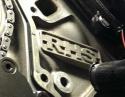


Irrelevant anyway, but the only picture you posted that actually has cross-drilled rotors is the Porsche. The M3 and ZR1 both have slotted rotors, which have already been discussed (pointless on a street car, used for a reason on a track car). Likewise, said slots have absolutely nothing to do with cooling the rotor, nor do they lend themselves to doing anything beneficial on a street car other than eating pads more quickly.
There are plenty of good threads about cross-drilled and slotted vs blanks in the suspension section, and plenty of good white pages on brake manufacturer sites if you want to read up on it. I'm going to /hijack before I get mod-slapped.


I love the discussion in this post..LOL. From what I have always researched to the original OP is that for strictly just a street car it's probably better to just get blanks unless you go to a high dollar cross driller/slotted rotor. Depending on the number of miles you have on your brakes I would try and take it to a reputable brake shop and see how much they can take off the rotor and see if the noise goes away. Your car already came with them so why not try that first. If it still is there then new rotors aren't that expensive for these cars. Just get all 4 new ones.




Thread Starter
Teching In
Joined: Sep 2010
Posts: 46
Likes: 0
From: Ft.Lauderdale, FL
I love the discussion in this post..LOL. From what I have always researched to the original OP is that for strictly just a street car it's probably better to just get blanks unless you go to a high dollar cross driller/slotted rotor. Depending on the number of miles you have on your brakes I would try and take it to a reputable brake shop and see how much they can take off the rotor and see if the noise goes away. Your car already came with them so why not try that first. If it still is there then new rotors aren't that expensive for these cars. Just get all 4 new ones.
Thanks for the input.

drilled/slotted rotors cause less contact surface area between the pad and rotor...therefore causing less friction and worse brakes....that is as long as your not on a track heating up really hot...