





1970 GTO Version 2.0

Thread Starter
Joined: Mar 2003
Posts: 10,617
Likes: 1,883
From: Little Austin

Really enjoyed reading this. Lot's of very useful information.
I'd already built several "hot rods" by the time you were born -- so you're
not really old (it's all relative anyway). I'm an ME (major in machine deign - minor in heat transfer) and about to retire.
I prefer to start with the pre WWII Fords. However, it doesn't matter which "canvass" you chose to paint on -- so long as you do first class work and pay attention to details.
Your GTO is a splendid example of the "hot rodders art".
I'll be pleased if my steel '32 roadster (LS7/T-56) turns out any where nearly as nice.
Congratulations on a job very well done!
I'd already built several "hot rods" by the time you were born -- so you're
not really old (it's all relative anyway). I'm an ME (major in machine deign - minor in heat transfer) and about to retire.
I prefer to start with the pre WWII Fords. However, it doesn't matter which "canvass" you chose to paint on -- so long as you do first class work and pay attention to details.
Your GTO is a splendid example of the "hot rodders art".
I'll be pleased if my steel '32 roadster (LS7/T-56) turns out any where nearly as nice.
Congratulations on a job very well done!
Yesterday I took the car to get the corner weight set and to make sure that my front sway bar was installed in such a way that it was not pre-loading the suspension. I took my car to Nashville, to Earl Owens Chassis. If anyone in that area needs any kind of fabrication or setup help, Earl knows his stuff.
Here are the new corner weights:
--LF------------------RF
1094-----------------1044
--LR-----------------RR
968-----------------913
This is with driver of similar weight to me.
Total: 4019 lbs
Distribution: 53.2 Front / 46.8% rear
Cross weight 50%
This was done with the front sway bar disconnected. Minor adjustments were needed on the drivers side rear spring jack to get the cross weight to 50%. Once the weights were adjusted I installed the sway bar in such a way that it did not alter any of the corner weights. I know that the sway bar was preloading the suspension fairly heavily before. This was evident by the fact that when I made right turns, the car would handle very neutral. There was just a hint of understeer that was easily controlled with the throttle. When making left turns the car would push much harder and the understeer was less controllable with the throttle.
Now the car handles the same way whether I am making left or right turns.
After installing the AFX spindles, I had to get the car aligned again. I decided to add just a hair more negative camber.
-.7* camber
5.5* caster ( little more on the right)
0 toe
The handling is very neutral. There is just a hint of understeer that is easily modulated with the throttle. The biggest difference is going over bumps, especially when just one wheel hits a bump. Before, the car would dart and wander. I have no doubt that this was cause by the bump steer due to the b-body spindle swap. With the AFX spindles all of that is gone. The car tracks straight as an arrow when going over bumps. There is a slight tendency to track along the grooves in the road, but I attribute that to the shorter sidewall on the new tires.
Andrew
Thread Starter
Joined: Mar 2003
Posts: 10,617
Likes: 1,883
From: Little Austin
Andrew
Thread Starter
Joined: Mar 2003
Posts: 10,617
Likes: 1,883
From: Little Austin
Tonight I decided to take the car to the drag strip to see how my new tires worked. I got to the track, did my burn out. The car pulled hard out of the hole. I was able to launch it from about 3000 RPM, slipping the clutch a little, no tire spin. On the 1-2 shift, it felt like I missed second. No big deal. I aborted the run. Stepped on the clutch and got nothing. No pressure at all. Straight to the floor. I matched the RPM and got the car into 3rd gear and drove back to the pits. Looked under the car and saw a nice little stream of fluid coming from the bellhousing. So the hydraulic TOB puked.
I now have less than 9 days until RTTH IV. I need to order a rebuild kit. I may even order a new TOB. I am not looking forward to spending the weekend on my back, but it's better that this happened now and now a week from now.
Andrew
I now have less than 9 days until RTTH IV. I need to order a rebuild kit. I may even order a new TOB. I am not looking forward to spending the weekend on my back, but it's better that this happened now and now a week from now.
Andrew
Sorry about your luck Andrew! I was finishing off my falkens last night night, they have TONS of life after there are no treads left, And they hook very well lol. But my night was cut short with a broken motor mount. No fun.
You'll have it back together!!! Very curious to see what your car will run on the strip.
You'll have it back together!!! Very curious to see what your car will run on the strip.
Thread Starter
Joined: Mar 2003
Posts: 10,617
Likes: 1,883
From: Little Austin
Calling Keisler will not do anything. This is not their issue. I am using a TOB from Quarter Master. I have a rebuild kit on the way and I also ordered the Howe TOB that is supposed to have internal stops as well as longer travel than the Quarter Master bearing. I am just not looking forward to pulling the transmission.
Andrew
Andrew
LS1 Tech Stories
The Best V8 Stories One Small Block at Time

Gas Monkey Built a 6-Wheel Ferrari Testarossa With a Corvette LT4 Engine
Verdad Gallardo
7 Most Reliable High-Performance Engines GM Has Ever Built
Verdad Gallardo
Amazing '71 Camaro Restomod Is Modern Muscle Car Under the Skin
Verdad Gallardo
6 Common C5 Corvette Failures and What's Involved In Repairing Them
Pouria Savadkouei
Retro Modern Bandit Pontiac Trans AM Comes With Burt Reynolds' Autograph
Verdad Gallardo
Top 10 Greatest Cadillac V Series Performance Models Ever, Ranked
Pouria Savadkouei
Top 10 Most Powerful Chevy Trucks Ever Made!

Hennessey's New Supercharged Silverado ZR2 Has 700 HP
Verdad Gallardo
Coachbuilt N2A Anteros Is an LS2-Powered C6 Corvette In Italian Clothes
Verdad Gallardo Thread Starter
Joined: Mar 2003
Posts: 10,617
Likes: 1,883
From: Little Austin
Calling Keisler will not do anything. This is not their issue. I am using a TOB from Quarter Master. I have a rebuild kit on the way and I also ordered the Howe TOB that is supposed to have internal stops as well as longer travel than the Quarter Master bearing. I am just not looking forward to pulling the transmission.
Andrew
Andrew
Thread Starter
Joined: Mar 2003
Posts: 10,617
Likes: 1,883
From: Little Austin


Thread Starter
Joined: Mar 2003
Posts: 10,617
Likes: 1,883
From: Little Austin
No mystery here:
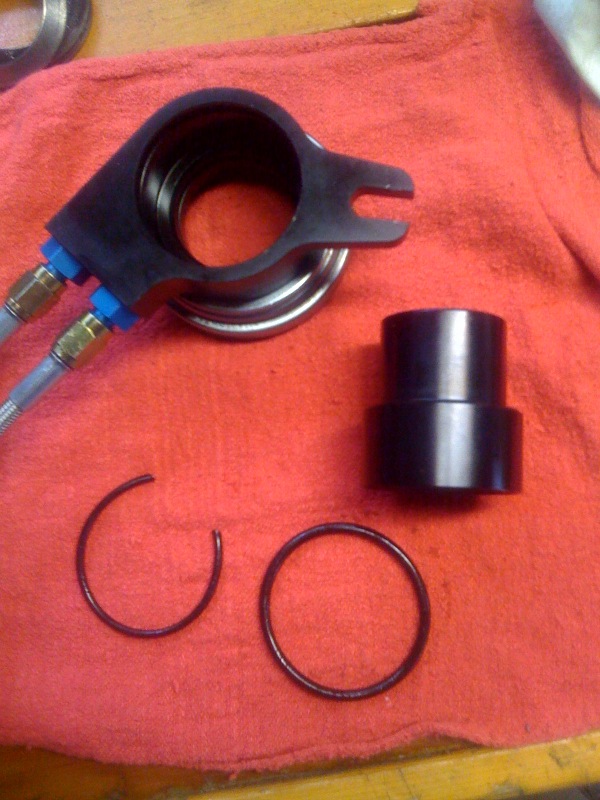
Based on the cut in the o-ring the problem was over traveling the bearing. I guess the excitement of drag racing made me press on the clutch pedal just a little bit more than when I drive around town. I will do some more investigating and see if I can limit the movement of the pedal and still get enough travel at the bearing to release the clutch.
Stay tuned for more.
Andrew
Based on the cut in the o-ring the problem was over traveling the bearing. I guess the excitement of drag racing made me press on the clutch pedal just a little bit more than when I drive around town. I will do some more investigating and see if I can limit the movement of the pedal and still get enough travel at the bearing to release the clutch.
Stay tuned for more.
Andrew

Not sure about other manual trans cars but I know E36 BMws had a threaded, adjustable stop that attached to the floor pan.
You could install it like this:

Check out this link for a low buck version:
http://www.wecool.net/bmw/ClutchStop/index.htm
--JMarsa
You could install it like this:
Check out this link for a low buck version:
http://www.wecool.net/bmw/ClutchStop/index.htm
--JMarsa
Last edited by jmarsa; Sep 5, 2008 at 03:32 PM.
Thread Starter
Joined: Mar 2003
Posts: 10,617
Likes: 1,883
From: Little Austin
Not sure about other manual trans cars but I know E36 BMws had a threaded, adjustable stop that attached to the floor pan.
You could install it like this:
Check out this link for a low buck version:
http://www.wecool.net/bmw/ClutchStop/index.htm
--JMarsa
You could install it like this:
Check out this link for a low buck version:
http://www.wecool.net/bmw/ClutchStop/index.htm
--JMarsa
I shortened the rod that connects the pedal to the MC. This reduced the stroke of the MC thus reducing the stroke of the TOB. I was still able to turn the output shaft easily by hand when the clutch was pressed. So I was definitely overtraveling the TOB before. Back on track for RTTH IV!
Andrew

Thread Starter
Joined: Mar 2003
Posts: 10,617
Likes: 1,883
From: Little Austin


Thread Starter
Joined: Mar 2003
Posts: 10,617
Likes: 1,883
From: Little Austin