







Reverse torquer cam (the other side of the coin)

I would think with the late EVO these reverse splits are seeing (40 bbdc as one example you gave) that in higher RPMs you're contaminating the intake charge anyway. Yes you're getting more out of your combustion, but you need more duration to clear the cylinder at 7000 than at 6000 in the same amount of time. Likewise, a higher compression will speed up the combustion process and the charge will be spent earlier, allowing an earlier EVO without any real TQ loss because of it. I can see where in instances where you are working with a lower compression lower rpm engine a reverse split might be optimal. I can't say that I see it's benefits in a max effort high rpm race engine though. I am speaking of course within the limits of the LSx world.
I try to use reverse splits whenever possible (pretty much anything but a sheetmetal intake).
Even the 222/222 cam on my site is an older grind and I now use a 223/218 .601/.558 cam in its place.
Amazingly, I have used reverse splits in L92 applications for people wanting to fatten the TQ curve over there cam set up. Even 408-427 strokers with 236/242 .6xx/.6xx 110-113 LSA cams see a HUGE increase in low/mid range TQ by using a 234/230 .600/.600 112 LSA cam and still make the same or more MORE HP at 6500 RPM also.
More duration (intake or exhaust) doesn't mean more power. If the valve is open, you are allowing air to enter/exit the cylinder and that is a good thing to an extent. You also have to worry about these things the valve being opn too long or opening/closing at the wrong time . . .
IVO- earleir you open the valve, the higher the lift point when the piston starts sucking on the port (good thing) but you have to watch the IVO/EVC and amount of overlap so you do not contaminate the mixture of next intake strtoke.
IVC- earlier you close the intake valve, the more cylinder pressure you trap and the later you close the intake valve, the less cylinder pressure you trap but a later IVC also allows a few extre degrees for cylinder filling and can make a lil more top end power.
EVO- earlier you open the exhaust valve, the sooner you stop pushing on the piston (blow down). This can hurt TQ at low RPM, mid range and even top end. If using enough nitrous or have enough intake flow (sheet metal intake, etc), you can see some HP at high RPM by an earleir EVO. Most people lose alot of TQ with too early of an EVO.
EVC- the later you close the ex valve (tighter LSA, larger ex duration lobe), the higher lift the valve is at when the piston nears TDC so you can get more air out of the cylinder but you have to worry about where the air is going and make sure it is going out the exhaust instead of up the intake port (reversion) during overlap. The earleir you close the exhaust valve, the less reversion you have to contend with.
Most LS1's will end up making more power by having a smaller ex lobe since you eliminate some of the problems with overlap by using an earlier EVC and not blowing down the cylinder by using a later EVO.
The lobes that I use are the Ultradyne and Bullet lobes. Lobes that have the same .006, .050 and .200 duration are not all the same. The Ultradyne/Bullet lobes I have are severely assymatrical and are MUCH fatter on the opening side. You can only close the valve at a certain rate and remain stable at high RPM so you are kinda fixed on how fast you can close the valve and the closing ramp speed of the lobe but you can open the valve alot more aggressively and put the valve at a higher lift sooner so the engine "thinks" that you have the intake on a lower centerline (starts filling intake sooner) but you knock off about 3 degrees of negative stuff during IVO (reversion) and EVO (blow down cylinder) so you make more power.
there are always trade offs but I believe if using a LS1, LS6 or fast 90 intake and spinning 6800 RPM or less, a reverse split will be the better choice.
Anyone with Desk top Dyno, Engine Analyzer Pro, etc might not see all of these benfits and even though Dynomation5 is still a program, it has alot more inputs and things to measure (cross sections, runner lengths, venturi diameters, etc) that will have a more realistic grasp on the pulses going through the engine (intake and exhaust). It si still a program, it is just a lil closer to "real life".
Lloyd
Even the 222/222 cam on my site is an older grind and I now use a 223/218 .601/.558 cam in its place.
Amazingly, I have used reverse splits in L92 applications for people wanting to fatten the TQ curve over there cam set up. Even 408-427 strokers with 236/242 .6xx/.6xx 110-113 LSA cams see a HUGE increase in low/mid range TQ by using a 234/230 .600/.600 112 LSA cam and still make the same or more MORE HP at 6500 RPM also.
More duration (intake or exhaust) doesn't mean more power. If the valve is open, you are allowing air to enter/exit the cylinder and that is a good thing to an extent. You also have to worry about these things the valve being opn too long or opening/closing at the wrong time . . .
IVO- earleir you open the valve, the higher the lift point when the piston starts sucking on the port (good thing) but you have to watch the IVO/EVC and amount of overlap so you do not contaminate the mixture of next intake strtoke.
IVC- earlier you close the intake valve, the more cylinder pressure you trap and the later you close the intake valve, the less cylinder pressure you trap but a later IVC also allows a few extre degrees for cylinder filling and can make a lil more top end power.
EVO- earlier you open the exhaust valve, the sooner you stop pushing on the piston (blow down). This can hurt TQ at low RPM, mid range and even top end. If using enough nitrous or have enough intake flow (sheet metal intake, etc), you can see some HP at high RPM by an earleir EVO. Most people lose alot of TQ with too early of an EVO.
EVC- the later you close the ex valve (tighter LSA, larger ex duration lobe), the higher lift the valve is at when the piston nears TDC so you can get more air out of the cylinder but you have to worry about where the air is going and make sure it is going out the exhaust instead of up the intake port (reversion) during overlap. The earleir you close the exhaust valve, the less reversion you have to contend with.
Most LS1's will end up making more power by having a smaller ex lobe since you eliminate some of the problems with overlap by using an earlier EVC and not blowing down the cylinder by using a later EVO.
The lobes that I use are the Ultradyne and Bullet lobes. Lobes that have the same .006, .050 and .200 duration are not all the same. The Ultradyne/Bullet lobes I have are severely assymatrical and are MUCH fatter on the opening side. You can only close the valve at a certain rate and remain stable at high RPM so you are kinda fixed on how fast you can close the valve and the closing ramp speed of the lobe but you can open the valve alot more aggressively and put the valve at a higher lift sooner so the engine "thinks" that you have the intake on a lower centerline (starts filling intake sooner) but you knock off about 3 degrees of negative stuff during IVO (reversion) and EVO (blow down cylinder) so you make more power.
there are always trade offs but I believe if using a LS1, LS6 or fast 90 intake and spinning 6800 RPM or less, a reverse split will be the better choice.
Anyone with Desk top Dyno, Engine Analyzer Pro, etc might not see all of these benfits and even though Dynomation5 is still a program, it has alot more inputs and things to measure (cross sections, runner lengths, venturi diameters, etc) that will have a more realistic grasp on the pulses going through the engine (intake and exhaust). It si still a program, it is just a lil closer to "real life".
Lloyd
On IVO - you mention IVO/EVC relation and the amount of overlap. Can you expand on that and relate it to the overlap bias in relation to TDC and where you prefer it to be?
On IVC - A later IVC and the extra degrees of cylinder fill have to be balanced with the pulse of the incoming air. If the pulse is weak (maybe due to too large a min CSA) then the benefit of the earlier IVC and dynamic compression would be of greater benefit.
On EVO - Again as I mentioned in my previous post, this is going to be affected by compression, rpm, and combustion efficiency/speed.
On EVC - If you picked the correct IVO, then you don't really have to worry as much about the EVC (the ram pulse should be strong enough to counter an effort for spent combustion to get into the intake tract). Also, the earlier the EVC (to cut a little reversion as you put it) you are effectively biasing overlap to the intake. How do you feel this can benfit high rpms?
I prefer an early IVC and compression to make my TQ, and a earlier EVO to clear the cylinder. I try not to bias overlap to the intake side. This is how I learned, and this is why reverse splits do NOT make sense to me.
I really do like your explanation on asymetrical lobes and I feel it's something that is way too often overlooked in the "internet world of performance" and I use that loosely. I was speaking so most people can understand, I'm sure you know already the what and why of what I wanted to add.

Thread Starter
TECH Senior Member
Joined: Mar 2004
Posts: 14,620
Likes: 17
From: BFE
Originally Posted by Paint-It-Black
I prefer an early IVC and compression to make my TQ, and a earlier EVO to clear the cylinder. I try not to bias overlap to the intake side. This is how I learned, and this is why reverse splits do NOT make sense to me.
Take this cam
230/228 110-1 LSA
4>IVO
46>IVC
43>EVO
5>EVC
109>ECL
9* overlap
Look at the graph and you can see that the relation of IVC/EVO is very important in making trq and how you position intake bias is what is allowing that cam to carry far into the rpms without falling on its face (with regards to reverse that is)
To understand a reverse you have to discard traditional thinking, because as long as you cling to that, they won't make sense.
However as you can see, they actualy act contrary to beliefs with the right valve events.
That engine is also ~ 11.2:1 SCR, 346 ci, CNC ported 243 heads 59cc, stock valves.
400lbs of trq at 3500 rpm

This is not a fluke, I have duplicated that in various cid.The discussion from the biginning is not about max effort Hp production, but about substantial increase in early rpm trq which cooked in the right combo will have lethal results at the track.
So why run 7500 rpm if you can do better work by 7000? (in race environment)
It is all about where you want to make that power in the band and how will you use it.
Bottom line, the combos between traditional and reverse splits are not the same and each cater to their parameters in a certain way. That is why one cannot look at them from the same angle.
Last edited by PREDATOR-Z; Oct 8, 2009 at 01:23 AM. Reason: cnc ported 243s
paint it black-
IVO- I believe you wantt very little overlap on these engines (more so than LT1, SB Chevy, etc) and I would bias the overlap slightly to the int side of things to give the intake more of a fighting chance to NOT suck in the exhaust.
I consider overlap the time both valves are open at the same tome (seat to seat) and also where each one is in relation to TDC.
A reverse split will automatically have a lil bias towards intake and so the ex. valve will be open less after TDC compared to intake when the piston starts sucking so you ahve a better chance of NOT sucking from the exhaust port. I understand pulses, etc, but when you start sucking on the header with valve open, the pulse will be killed in my views.
IVC- The LONG runners on the LS1 are gonna have a stronger and longer pulse for better cylinder filling for a few degrees after the piston stops sucking on the port (compared to LT1, SBC single palne, etc) and my comment was that the people that use "DCR only" to determine IVC will be missing out on some power.
EVO- gear, stall, shift RPM, how much low end TQ you need or can sacrifice would be my criteria for EVO. Most have it happening too early IMO and the reverse split helps that.
You can come up with reasons on paper for the reverse split to work and not to work if you look hard enough. I am going by what I see time and time again and that is that they DO work then I will try to explain why they do based on my limited knowledge and everything I can read or punch into an engine simulation program.
If your mind is made up, i am not here to change it but if you have an open mind as to what really works, try it and you will change your mind. I was of the same thinking that real tight LSA's (104-108) were the way to go and you need 6-8 degrres larger ex lobe for street engines and 8-12 degrees for high RPM stuff but the more I do this stuff and get bac to back results, it has swayed my thinking on LSA and how much split you need. I will say that the LS1 is the only engine I have seen this work well on (other rthan turbo stuff).
===============================================
This is very important for most to read to I will outline it since it is mid post. .. . . . . .
Most people call up and say there buddy has x cam and they wanna make more power so they need a bigger cam. They actually need less duration so they can trap cylinder pressure, push down on the piston harder and longer, etc so when you tell them what cam they need, some thing you are crazy telling them a 230/226 cam will make more power than there buddys 238/246 cam.
On the BIG cam, the valves are open so long that there is obviously more air
going in and out of the cylinders but they can't grasp that when the valves are open all that time, you are not trapping cylinder pressure, you blow down the cylinder too early and you have alot of reversion with exhaust going up intake and intake pulse going out the exhaust.
The car is gonna be fast because we have clean air in the cylinders and push down hard on the piston for a long time. Having air swishing around in/out of the cylinders is not the reason a car is fast.
================================================== =====
Some just can't grasp this and do not buy a cam from me after hearing the specs I suggest. Some go a head and try it and are thrilled. The easiest customer is the one that doesn't read the forums or listen to there buddies about how big of a cam they think they need.
Lloyd
IVO- I believe you wantt very little overlap on these engines (more so than LT1, SB Chevy, etc) and I would bias the overlap slightly to the int side of things to give the intake more of a fighting chance to NOT suck in the exhaust.
I consider overlap the time both valves are open at the same tome (seat to seat) and also where each one is in relation to TDC.
A reverse split will automatically have a lil bias towards intake and so the ex. valve will be open less after TDC compared to intake when the piston starts sucking so you ahve a better chance of NOT sucking from the exhaust port. I understand pulses, etc, but when you start sucking on the header with valve open, the pulse will be killed in my views.
IVC- The LONG runners on the LS1 are gonna have a stronger and longer pulse for better cylinder filling for a few degrees after the piston stops sucking on the port (compared to LT1, SBC single palne, etc) and my comment was that the people that use "DCR only" to determine IVC will be missing out on some power.
EVO- gear, stall, shift RPM, how much low end TQ you need or can sacrifice would be my criteria for EVO. Most have it happening too early IMO and the reverse split helps that.
You can come up with reasons on paper for the reverse split to work and not to work if you look hard enough. I am going by what I see time and time again and that is that they DO work then I will try to explain why they do based on my limited knowledge and everything I can read or punch into an engine simulation program.
If your mind is made up, i am not here to change it but if you have an open mind as to what really works, try it and you will change your mind. I was of the same thinking that real tight LSA's (104-108) were the way to go and you need 6-8 degrres larger ex lobe for street engines and 8-12 degrees for high RPM stuff but the more I do this stuff and get bac to back results, it has swayed my thinking on LSA and how much split you need. I will say that the LS1 is the only engine I have seen this work well on (other rthan turbo stuff).
===============================================
This is very important for most to read to I will outline it since it is mid post. .. . . . . .
Most people call up and say there buddy has x cam and they wanna make more power so they need a bigger cam. They actually need less duration so they can trap cylinder pressure, push down on the piston harder and longer, etc so when you tell them what cam they need, some thing you are crazy telling them a 230/226 cam will make more power than there buddys 238/246 cam.
On the BIG cam, the valves are open so long that there is obviously more air
going in and out of the cylinders but they can't grasp that when the valves are open all that time, you are not trapping cylinder pressure, you blow down the cylinder too early and you have alot of reversion with exhaust going up intake and intake pulse going out the exhaust.
The car is gonna be fast because we have clean air in the cylinders and push down hard on the piston for a long time. Having air swishing around in/out of the cylinders is not the reason a car is fast.
================================================== =====
Some just can't grasp this and do not buy a cam from me after hearing the specs I suggest. Some go a head and try it and are thrilled. The easiest customer is the one that doesn't read the forums or listen to there buddies about how big of a cam they think they need.
Lloyd
Thread Starter
TECH Senior Member
Joined: Mar 2004
Posts: 14,620
Likes: 17
From: BFE
The reasoning for traditional splits is also largely based on the intake to exhaust ratio of the heads, add that to the market desire to always have astronomical *peak* dyno numbers; poeple tend to miss the part where the true question should be *Where do I want my power band*.
Have you ever noticed that if you have a car with a big intake duration, high overlap, the first thing poeple recommend is tighter diferential gears?
Why is that?
And the answer is always *To bring you in your powerband quicker*
Well with reverse splits, that is not the case, your powerband starts earlier, negating the need to resort to 4.11 or higher gears. If your *power band* starts at 3000 rpm instead of 4500 rpm, you'll have similar results just running 3.2>3.5:1 ratios.
Your band will also last longer and be less peaky (depending on valve events). thus not needing to spin 1000 rpm past your peak to actualy perform the same work.
As Lloyd, I and a very few others found, there is more than one way to skin a cat, and it is not always the best to rely on paper physics to solve an issue.
Sometimes if the improbable is a reality, one can only deduct that therefore it is probable (otherwise known as out of box thinking or anarchy with regard to mainstream)
Have you ever noticed that if you have a car with a big intake duration, high overlap, the first thing poeple recommend is tighter diferential gears?
Why is that?
And the answer is always *To bring you in your powerband quicker*
Well with reverse splits, that is not the case, your powerband starts earlier, negating the need to resort to 4.11 or higher gears. If your *power band* starts at 3000 rpm instead of 4500 rpm, you'll have similar results just running 3.2>3.5:1 ratios.
Your band will also last longer and be less peaky (depending on valve events). thus not needing to spin 1000 rpm past your peak to actualy perform the same work.
As Lloyd, I and a very few others found, there is more than one way to skin a cat, and it is not always the best to rely on paper physics to solve an issue.
Sometimes if the improbable is a reality, one can only deduct that therefore it is probable (otherwise known as out of box thinking or anarchy with regard to mainstream
) this thread is long and old, so i havent read all of the posts, but i just thought id give my 2 cents.
all of loyd elliots LS cams are either the same on int. and exh., or they are a reverse split. so there must be something to it.....
this is right off his site...
218/214 .578/.578 114 LSA - "sleeper cam" with smooth idle and TONS of TQ at every
RPM from idle to 6000 RPM. This cam is a "torque monster".
222/222 .600/.600 112 LSA - mild idle, can be used with stock gears and no stall.
Good all around power. 1500-6200 RPM
226/226 .600/.600 112 LSA - aggressive idle, works well with 2800 stall and
3.42/3.73 gears. 1800-6500 RPM.
230/226 .600/.600 113 LSA - choppy idle, works well with 3200-3600 stall and
3.73/4.11 gears. 2100-6800 RPM.
234/230 .600/.600 113 LSA - great cam for stroker engines wanting strong mid range and top end power. Works best with 3600-4400 stall and 3.73/4.11 gears. 2500-6800 RPM.
if anyone is running this sleeper cam with tons of torque, id like to hear a sound clip!!!! or any of these cams for that matter....
all of loyd elliots LS cams are either the same on int. and exh., or they are a reverse split. so there must be something to it.....
this is right off his site...
218/214 .578/.578 114 LSA - "sleeper cam" with smooth idle and TONS of TQ at every
RPM from idle to 6000 RPM. This cam is a "torque monster".
222/222 .600/.600 112 LSA - mild idle, can be used with stock gears and no stall.
Good all around power. 1500-6200 RPM
226/226 .600/.600 112 LSA - aggressive idle, works well with 2800 stall and
3.42/3.73 gears. 1800-6500 RPM.
230/226 .600/.600 113 LSA - choppy idle, works well with 3200-3600 stall and
3.73/4.11 gears. 2100-6800 RPM.
234/230 .600/.600 113 LSA - great cam for stroker engines wanting strong mid range and top end power. Works best with 3600-4400 stall and 3.73/4.11 gears. 2500-6800 RPM.
if anyone is running this sleeper cam with tons of torque, id like to hear a sound clip!!!! or any of these cams for that matter....
After I get this LQ4 built, I think I will be purchasing that sleeper cam (or something similar) for my Yukon... It needs some help with that passing gear!
I too am curious to hear peoples thoughts on a reverse split/Pro-FLo XT combo. I just picked one up myself and will be trying to use it to its full advantage making gobs of torque under the curve. My combo will be 90mm/pro-flo, stock heads and 1 3/4" open long tubes. I feel that on a stock headed motor and this intake setup a reverse split would create an awesome combination, exhaust flow isn't much of a concern for my setup.
check out this link
https://ls1tech.com/forums/generatio...-383-dyno.html
this guy picks up 30rwhp/30torque when adding a 3in y and a "retarded" "band aid" cam over his previous 226/226 cam. so much for reverse splits not working in bigger cubes.
its a very old thread. but look at the power that reverse split was making in a 383 back then. for a small cam that is very drivable, and easy on the springs. and imagine if that setup had the great performing heads out today like the TFS, AFR and a ported fast.
https://ls1tech.com/forums/generatio...-383-dyno.html
this guy picks up 30rwhp/30torque when adding a 3in y and a "retarded" "band aid" cam over his previous 226/226 cam. so much for reverse splits not working in bigger cubes.
its a very old thread. but look at the power that reverse split was making in a 383 back then. for a small cam that is very drivable, and easy on the springs. and imagine if that setup had the great performing heads out today like the TFS, AFR and a ported fast.
Last edited by TXZ28LS1; Oct 8, 2009 at 10:53 AM.
LS1 Tech Stories
The Best V8 Stories One Small Block at Time

6 Common C5 Corvette Failures and What's Involved In Repairing Them
Pouria Savadkouei
Retro Modern Bandit Pontiac Trans AM Comes With Burt Reynolds' Autograph
Verdad Gallardo
Top 10 Greatest Cadillac V Series Performance Models Ever, Ranked
Pouria Savadkouei
Top 10 Most Powerful Chevy Trucks Ever Made!

Hennessey's New Supercharged Silverado ZR2 Has 700 HP
Verdad Gallardo
Coachbuilt N2A Anteros Is an LS2-Powered C6 Corvette In Italian Clothes
Verdad Gallardo
Awesome K5 Blazer Restomod Comes With C7 Corvette Power
Verdad Gallardo
10 Camaros You Should Never Buy

10 LS Engine Myths That Refuse to Die
Verdad Gallardo

-Brandon





Not exactly sure why, I have never LOST power going to a correct "traditional" camshaft from a true reverse split. Some of the so called "reverse split cams" are actual single or dual pattern cams in terms of valve curtain area anyway?(soft intake lobes, aggressive exh lobes, which is exactly the opposite of what NA motors want in my experience testing, and ends up being similair in terms of lobe area)
More gimmickry than anything with alot of it. Never had a reverse split anything, no matter how big make over 400 cam only on any dynojet that ive used, or on mine. Ive done at least 50 others though that made that or +, and no not just donkey dick big stuff?
More gimmickry than anything with alot of it. Never had a reverse split anything, no matter how big make over 400 cam only on any dynojet that ive used, or on mine. Ive done at least 50 others though that made that or +, and no not just donkey dick big stuff?
If you look at these two threads:
https://ls1tech.com/forums/dynamomet...tq-411-hp.html
https://ls1tech.com/forums/dynamomet...-cam-only.html
You'll see why a lot of people like the reverse split.
https://ls1tech.com/forums/dynamomet...tq-411-hp.html
https://ls1tech.com/forums/dynamomet...-cam-only.html
You'll see why a lot of people like the reverse split.
Last edited by NodnarB; Sep 27, 2010 at 06:35 AM.

well i didnt read all the pages (will this work, will that work, etc) but you can also achieve a basic reverse split on a semi-agressive standard split by running a split rocker ratio - ie 1.8 intakes and 1.7 exhaust. Exhaust doesnt usually seem to like the quicker valve accelleration a higher ratio gives, and this tactic is done quite often on sbc builds. 1.6 or 1.65 intakes with a 1.5 exhuast. Just make sure the valve spring can handle the extra lift on the intake valve.
For a budget build you can even use ls-7 exhaust rockers on the intake (correct me if im wrong) for a traditional head, since its a 1.8 no ofset. If the ls3/l92 are 1.7 as well, ls-7 intakes (1.8) should do it as well. This adds very little seat duration but a little more area under the curve.
Im doing this on my build, but its a mild 5.3 (going in a jimmy) and Im doing it to add a little more intake duration/area to the small cam i have, in an attempt to spread the power out higher without loosing much/any bottom. (flattop l33 bottom,home ported stock valve 5.3 heads 10.5 comp, ls1 cam, ls6 springs, slp 1.8 intake rockers) I may try the 01 ls-6 cam the 1.8 intake ratio if the ls1 cam seems to small.
For a budget build you can even use ls-7 exhaust rockers on the intake (correct me if im wrong) for a traditional head, since its a 1.8 no ofset. If the ls3/l92 are 1.7 as well, ls-7 intakes (1.8) should do it as well. This adds very little seat duration but a little more area under the curve.
Im doing this on my build, but its a mild 5.3 (going in a jimmy) and Im doing it to add a little more intake duration/area to the small cam i have, in an attempt to spread the power out higher without loosing much/any bottom. (flattop l33 bottom,home ported stock valve 5.3 heads 10.5 comp, ls1 cam, ls6 springs, slp 1.8 intake rockers) I may try the 01 ls-6 cam the 1.8 intake ratio if the ls1 cam seems to small.



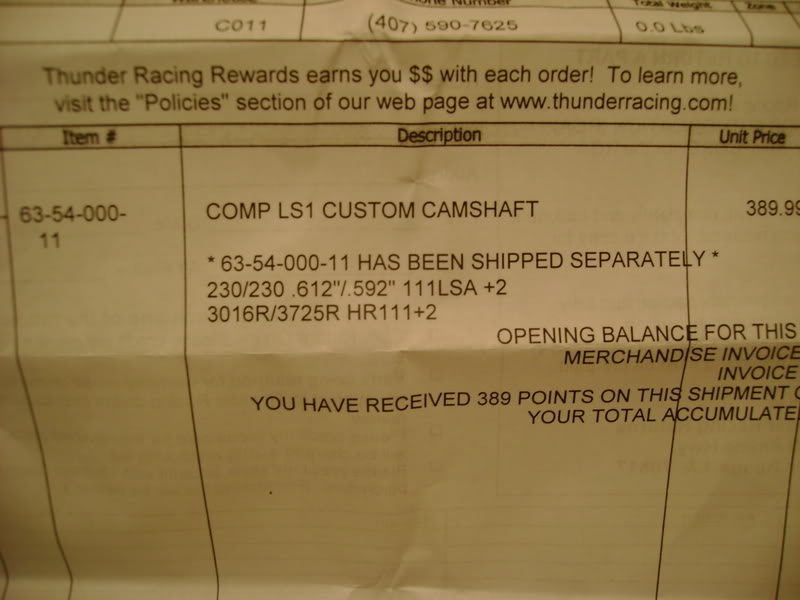
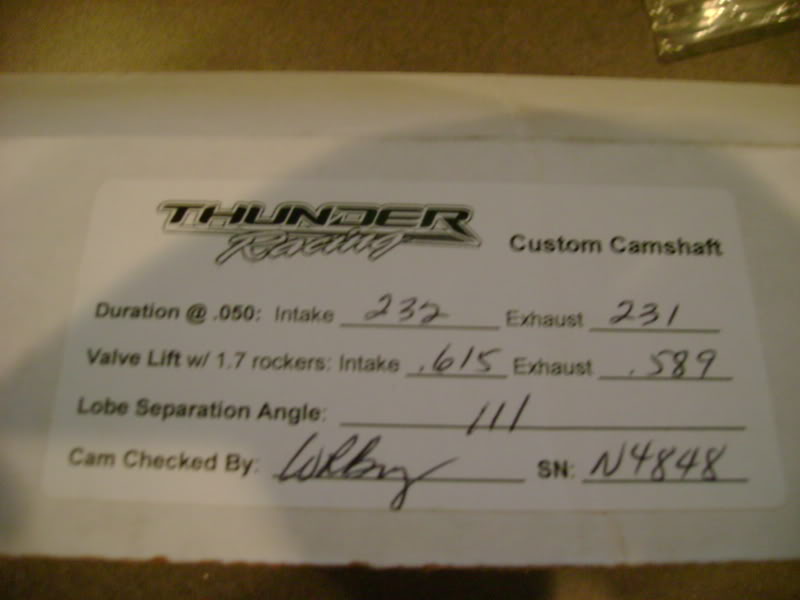
i'm looking at gettin the El Torro, a few questions first. how do i go about ordering it? lol since it's predator-z's spec i was gonna try to get a hold of him but last i checked his PM has been disabled so i'm wondering if TR has the cam on file somewhere or something and the second question is i though i read somewhere that the el torro cam 230/230 is a reverse split, i can't find where i read it and i'd like to see if i read the right thing. i know when reverse split is said people think of TR230/224 or TR236/230 so to me in my mind a 230/230 is a traditional split. hopefully predator or someone else can confirm or correct this
cam order sheet from TR
sticker on side of TR box assuming the cam doctor numbers
cam order sheet from TR
sticker on side of TR box assuming the cam doctor numbers